7 Key Principles Of Effective Data Protection

IBM’s 2025 Cost of a Data Breach Report pegs the global average breach cost at 4.44 million dollars, down 9 percent year over year, while the United States hit a record 10.22 million dollars on average, driven by fines and detection costs that keep rising in high‑regulation markets. Verizon’s 2025 DBIR analyzed 22,052 incidents and 12,195 confirmed breaches, finding ransomware in 44 percent of breaches and a surge in third‑party compromises to 30 percent, a signal that supply chain and shared cloud platforms remain hot targets.
Here is the thing: Microsoft’s Midnight Blizzard intrusion and the Snowflake‑linked data thefts that rippled across Ticketmaster and Santander pushed a hard truth into boardrooms. Enterprise risk now turns on identity hygiene, software supply chain choices, and how fast teams can govern and recover at scale. Investors see the regulatory pressure too, with cumulative GDPR fines crossing billions and headline penalties like TikTok’s 530 million euro hit underscoring that privacy enforcement is not slowing down.
After the peak of hype, practical data protection now mixes governance, zero trust identity, encryption, segmentation, memory‑safe software, vendor risk controls, and rehearsed incident response to blunt both costs and consequences from modern breaches. The Microsoft and Snowflake story arcs show how quickly third‑party access, legacy accounts, and token theft can pivot into broad exposure, which is why principles that inventory data, minimize it, and lock keys down matter more than ever. The smell here is that many organizations still treat AI, SaaS, and shared clouds as exceptions to policy, when regulators, attackers, and customers do not.
Key Data
IBM says the global average breach cost fell to 4.44 million dollars, but the US average rose to 10.22 million dollars, reflecting faster detection globally and tougher fines and escalation costs in America.
Verizon’s 2025 DBIR shows ransomware in 44 percent of breaches, stolen credentials in 22 percent of initial access, exploited vulnerabilities in 20 percent, and third‑party involvement doubling to 30 percent.
GDPR enforcement continues to bite, with cumulative fines in the billions and a 530 million euro penalty for TikTok this year, highlighting cross‑border data transfer risk.
Connecting Data to Principles
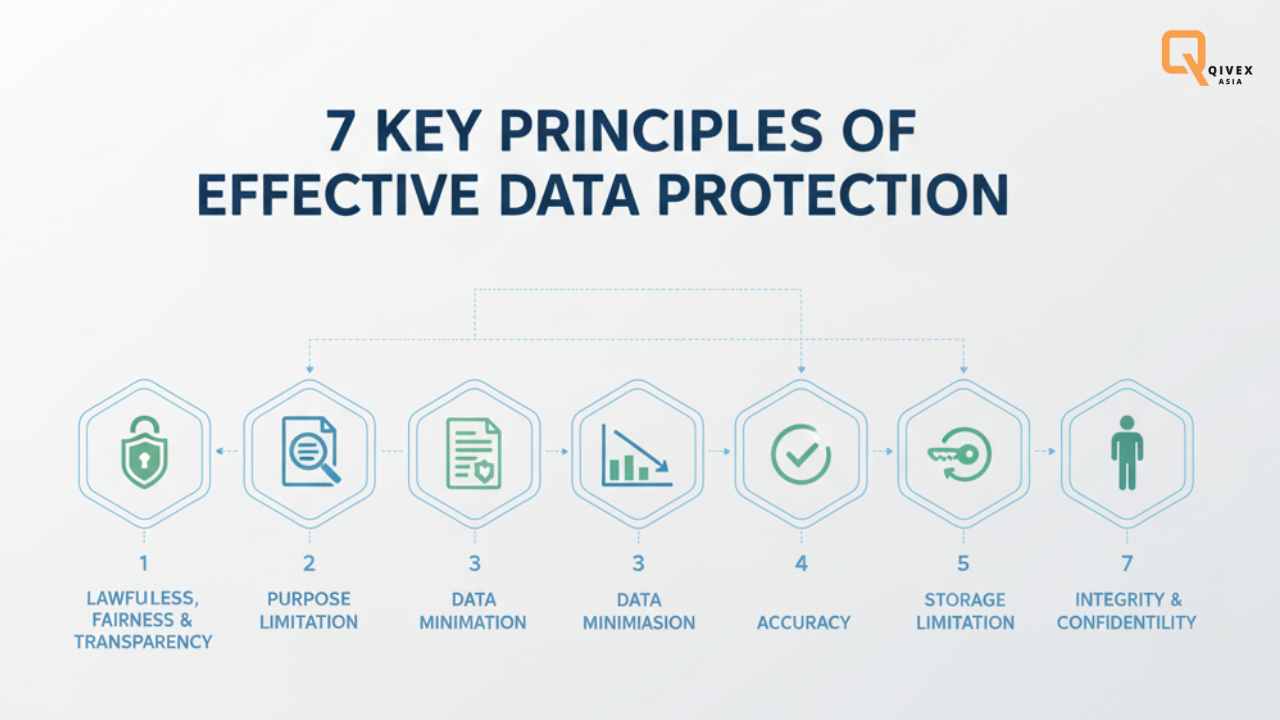
Those numbers point to a simple mandate: govern cyber as enterprise risk, reduce the blast radius before attackers land, and practice recovery like revenue depends on it because it does. The data maps cleanly to seven principles, a governance backbone, data inventory and minimization, strong identity and least privilege, encryption and key management everywhere, segmentation with continuous monitoring, secure software and supply chain with memory‑safe defaults, and an incident response program that is tested and funded. If that looks like NIST CSF 2.0 on purpose, that is because the updated framework added a Govern function and clearer language for supply chain and risk alignment across the business.
7 Key Principles of Effective Data Protection: Step‑by‑Step Guide
1. Govern Cyber as Enterprise Risk
CSF 2.0 makes governance explicit, elevating cyber alongside finance and reputation so leaders can set risk appetite, assign roles, fund controls, and measure outcomes across Identify, Protect, Detect, Respond, and Recover. Boards now face evidence that breach costs cluster where governance is weak. In the US, the average soared to 10.22 million dollars as fines and escalation spending climbed, which should push executive ownership beyond paper policies.
Adopt CSF 2.0 profiles and tiers to benchmark the current posture and target state, then tie program KPIs to board‑level reporting so cyber is tracked like any material risk. If sources say the next earnings cycles will press for cyber progress, it is because regulators and markets already price that risk into valuations and insurance.
2. Know the Data and Minimize It
Data protection starts with a living inventory, tagging sensitive classes, mapping flows across SaaS, cloud, and endpoints, then minimizing what is stored and how long it is retained to cut exposure and compliance scope. GDPR enforcers keep reminding companies that transfers without equivalent safeguards will draw penalties; a 530 million euro fine for TikTok is the latest proof that data locality and lawful bases matter.
Build automated discovery and classification into pipelines and collaboration tools so shadow stores and unstructured content are visible, then enforce retention and deletion to reduce harm when incidents occur. The Snowflake‑linked cases show how third‑party repositories can balloon surface area, so include shared analytics and demo environments in data maps, not just production datasets.
3. Identity First, Least Privilege Always
Verizon’s DBIR again shows stolen credentials and vulnerability exploits as top initial access paths, so strong authentication, conditional access, and rapid credential rotation are non‑negotiable. Least privilege and zero standing access reduce the blast radius when tokens or session files leak, lessons reinforced by the Okta support breach, where HAR files and stolen credentials enabled downstream attacks.
Legacy accounts remain a soft spot. Microsoft disclosed that Midnight Blizzard used a password spray to compromise a legacy account, which then exposed corporate email and later enabled attempts against source code repositories and internal systems. Enforce phishing‑resistant MFA, device trust, privileged access management, and continuous session risk evaluation because the best time to block persistence is before it starts.
4. Encrypt Everything and Manage Keys Like Crown Jewels
Encryption at rest, in transit, and increasingly in use with confidential computing should be table stakes, but key management discipline decides whether the math helps during a breach. Separate key custody, rotate often, restrict export, and log all access, then verify that SaaS and data platforms support customer-managed keys for the most sensitive workloads.
Tie data classification to keying policies; high sensitivity means stronger controls and shorter rotation windows, while low sensitivity can ride standardized service defaults to keep teams moving. Regulators care about effective safeguards, not just checklists, so treat crypto failures as a reportable gap in the overall control story and fix them fast.
5. Segment, Monitor, and Patch the Edge
System intrusion and web app attacks dominate, and Verizon reports edge and VPN flaws up eightfold, with only 54 percent patched on median timelines, which is an engraved invitation for lateral movement. Microsegment critical apps, isolate management planes, and watch east‑west traffic so noisy pivots do not roam freely inside flat networks that attackers love.
Modern detection must correlate identity, endpoint, network, and SaaS telemetry to catch token replay, OAuth abuse, and privilege escalation that classic perimeter tools miss. Patch hygiene still matters; the median fix time of 32 days on exposed edge services tells adversaries which doors to knock first, so shrink it with automation and clear ownership.
6. Secure the Software and the Supply Chain
CSF 2.0 elevates governance of supply chain risk, but execution hinges on SBOMs, verified builds, signed artifacts, dependency health, and least privilege across CI and runtime. CISA and NSA now urge adoption of memory‑safe languages to cut entire classes of vulnerabilities at the root, shifting safety from developer vigilance to the language and tooling.
That guidance is not academic; unsafe components and FFI seem to keep reintroducing memory bugs even into otherwise safe codebases, so program roadmaps must include refactoring and safe wrappers. The Snowflake‑linked wave shows how supply chain exposure multiplies, so it requires vendors to prove secure defaults, MFA, logging, and rapid response processes before granting access to sensitive datasets.
7. Practice Response and Build Resilience
Breaches are about speed now. IBM ties lower global averages to faster detection and containment, often with help from automation, which is the blueprint to keep costs and chaos down. Tabletops with legal, PR, and business leaders should rehearse regulator notifications, customer communications, and takedown plays for leaked tokens and stolen session material.
Backups need isolation and frequent restore drills; ransomware median payouts may have fallen, but attacker dwell times and third‑party pivots make recovery readiness the deciding factor in business continuity. Here is the truth: smart teams close incidents with postmortems that change policy and funding, not just patches, and that is how breach math improves next quarter.
People of Interest or Benefits
When Congress questioned Microsoft’s handling of recent intrusions, President Brad Smith accepted responsibility and said the company is addressing every recommendation from the CSRB and that the Midnight Blizzard and Storm‑0558 attacks could have been prevented, a rare admission at that scale that should reset expectations across the industry. Reuters echoed the accountability narrative, noting lawmakers pressed on security practices and ties to China, which adds geopolitical weight to an already technical story that CISOs must translate into risk actions.
The pivot inside Redmond is notable, with external coverage highlighting moves to tie compensation to security outcomes, which boards everywhere can copy to align incentives with risk posture, and sources say more vendors will follow as customers and regulators demand it. NIST’s Laurie Locascio offered the other half of the picture: CSF 2.0 is framed as a suite of resources for all organizations, which means the governance language and profiles give executives a common map to show progress without drowning everyone in jargon.
Looking Ahead
Analysts and incident responders now expect third‑party breaches to remain elevated because partner ecosystems keep expanding and exposed edge surfaces still lag patch cycles, which matches DBIR’s jump to 30 percent supply chain involvement. The AI oversight gap will also widen before it narrows.
IBM’s findings show that almost all organizations hit by AI‑related breaches lacked proper AI access controls, and many still lack formal AI security policies that bind data protection to model use. Expect regulators to probe cross‑border data flows around AI copilots and agents, especially where personal data and sensitive business artifacts move into vendor‑run environments and new memory stores, which sit squarely in GDPR enforcement lanes that already tally in the billions.
On the market side, platform vendors will push integrated AI security and data security stacks. Palo Alto’s Prisma AIRS pitch is one example of how tools are converging around models, agents, and data, but buyers should map capabilities to the seven principles, not slide decks.
Closing Thought
If Microsoft ties compensation to verifiable security outcomes and enterprises normalize CSF‑aligned governance with AI‑aware controls, breach math can finally turn, but will boards make the same call before the next headline or after it lands? This smells like a turning point; either incentives move now, or attackers will keep proving the point at someone else’s expense, probably again through a third‑party that looked safe until yesterday.