How DAOs Are Funding Scientific Discovery: The Ultimate 2026 DeSci Guide
Scientific work has always depended on money. Labs need equipment. Graduate students need stipends. Long experiments demand time and patience. Yet many scientists spend months, sometimes years, chasing grants rather than testing ideas. The old grant system works for some projects, though it often favors well-known institutions and familiar research paths.
A different model has started to appear over the past few years. Groups organized on blockchain networks now pool money from people across the world and direct it toward research projects. These groups are called Decentralized Autonomous Organizations (DAOs), and they sit at the center of a wider movement known as Decentralized Science (DeSci).
Supporters believe these networks could open new paths for funding research. Critics raise fair concerns about governance, regulation, and scientific rigor. The truth likely sits somewhere in between. Still, early experiments already show how community-run funding might reshape how discoveries begin.
What Is a DAO in the Context of Scientific Research?

A DAO works as a digital organization whose rules live in code. Members hold tokens that allow them to vote on decisions. Those decisions might include approving research proposals, funding experiments, or distributing intellectual property rights tied to discoveries.
In the research world, a DAO often collects funds from contributors across the globe. Once a proposal enters the system, members review it and cast votes. If enough people support the idea, money moves from the treasury to the research team. The process occurs through smart contracts that execute the result automatically.
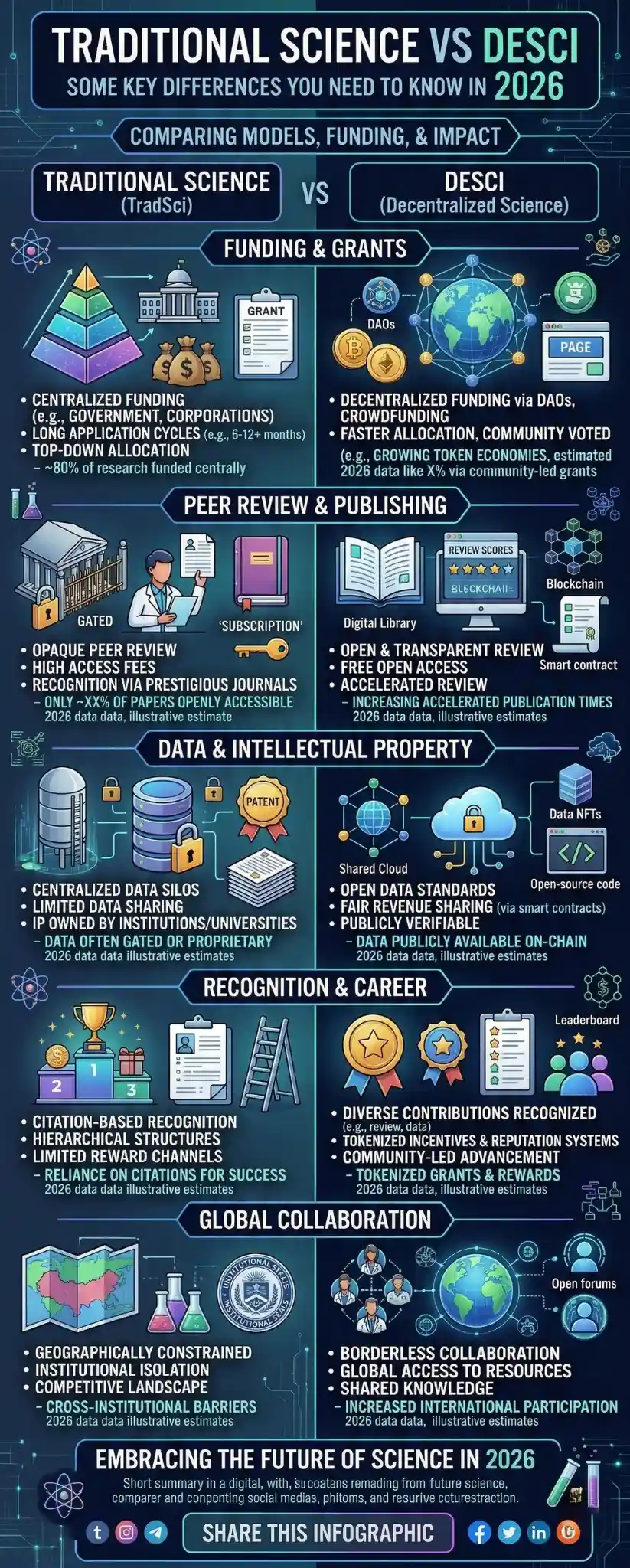
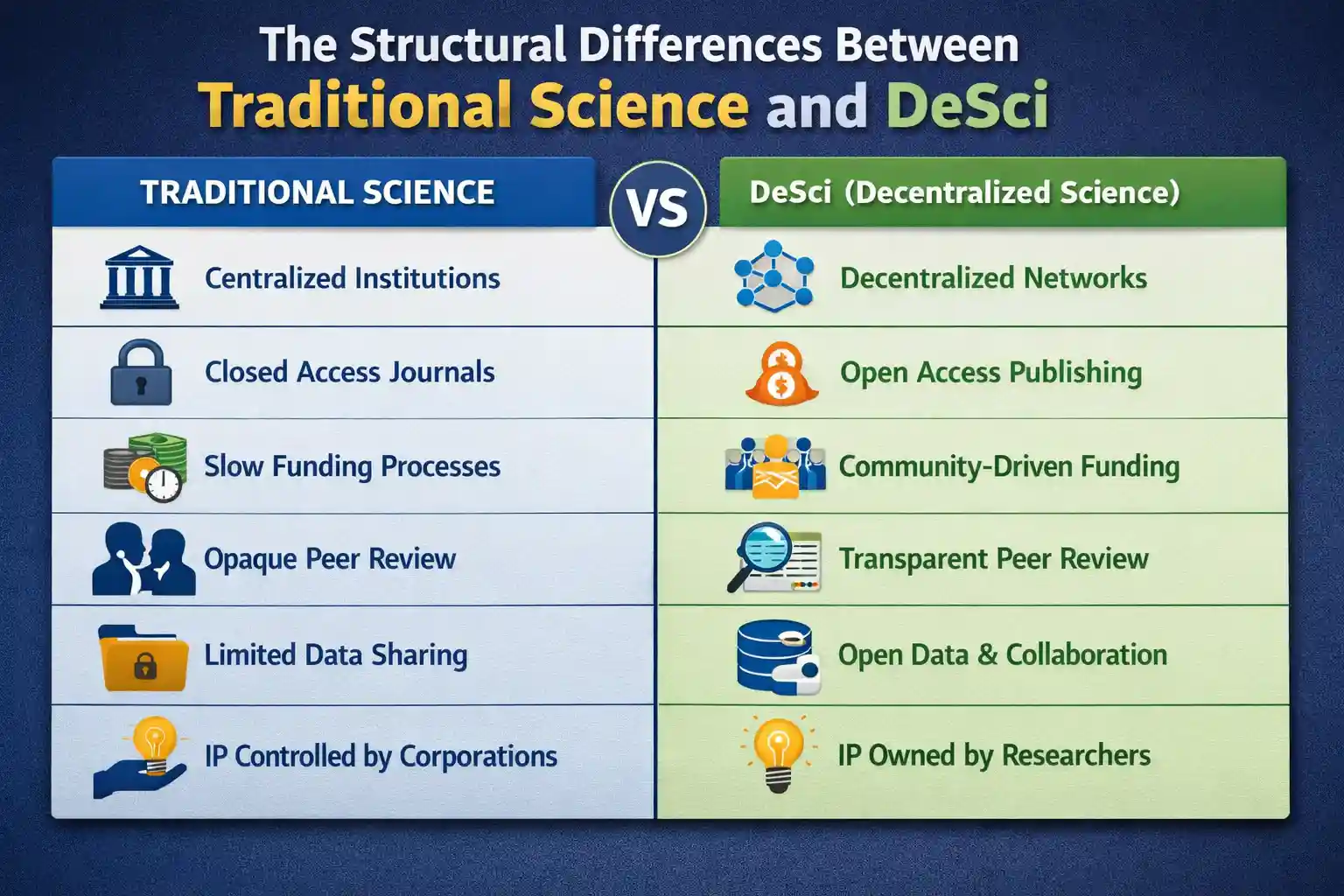
This approach shifts authority away from a single funding body. Traditional research funding usually flows through government agencies, large foundations, or venture capital. DAO-based funding spreads that power across a wider community. In theory, anyone holding tokens may participate in the decision.
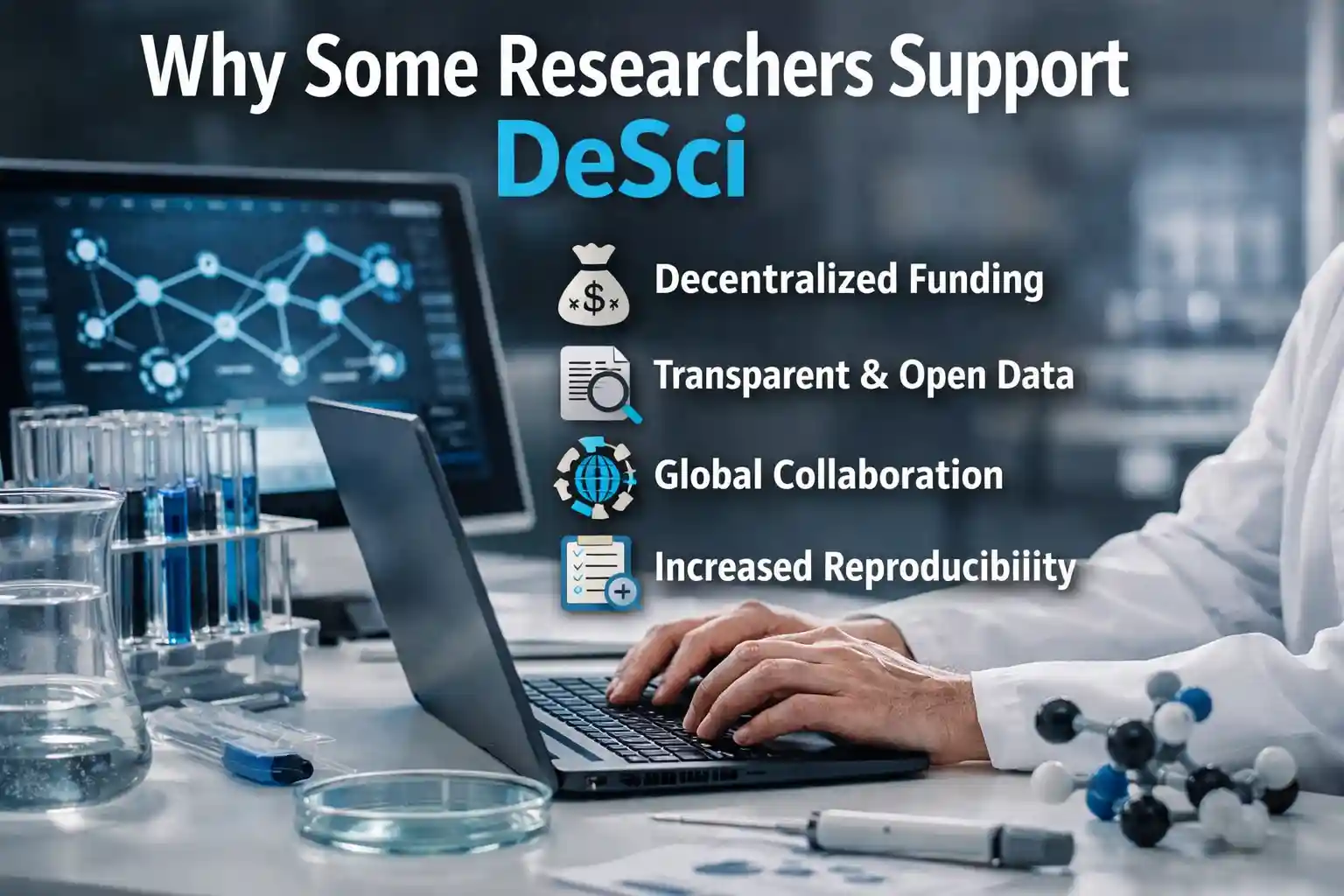
The idea rests on the belief that knowledge should not sit behind closed institutional doors. Decentralized science groups argue that open networks can improve access to funding, widen participation, and allow unconventional ideas to reach early support.
The Roots of Decentralized Science

The rise of DeSci did not appear out of thin air. Many researchers have long criticized the academic system. Grant competitions often accept only a small percentage of proposals. Younger scientists without strong institutional ties may struggle to secure funding.
Another issue appears in the time researchers spend applying for grants. Some reports suggest scientists devote large portions of their working hours to writing applications and waiting through long review cycles.
Blockchain technology entered this debate as an experiment rather than a guaranteed fix. Advocates suggested that decentralized networks could support new funding pools. They also argued that blockchain could record research contributions, data sharing, and peer review activity in transparent ways.
That vision slowly formed a loose movement. Developers, scientists, and investors began forming online communities dedicated to rebuilding parts of the research pipeline. The term Decentralized Science, shortened to DeSci, gained traction around the early 2020s.
Today, dozens of projects claim some connection to that idea. Some focus on data sharing. Others explore new ways to handle research ownership. A growing group concentrates on funding scientific work.
Why Traditional Research Funding Faces Pressure
The traditional model still produces important discoveries. Yet it also carries structural limits that researchers discuss often in academic circles.
Grant committees must evaluate thousands of proposals every year. Reviewers rely on past publications, institutional affiliation, and previous funding success as signals of credibility. Those signals can favor established labs over emerging researchers.
Risk also plays a role. Agencies often fund projects with predictable outcomes. Early-stage ideas, which may fail yet could lead to major breakthroughs, sometimes struggle to secure support.
Another challenge lies in what researchers call the “valley of death.” This gap appears between early scientific discovery and the stage where a project becomes commercially viable or attractive to large investors. Promising ideas sometimes stall in that gap.
DAO-based funding aims to fill part of that space. By pooling money from many contributors and allowing communities to vote on proposals, these groups try to support research that traditional systems overlook.
How DAO Funding for Science Actually Works
A research DAO usually begins with a treasury. Contributors send funds, often in cryptocurrency, to a shared wallet controlled by smart contracts. Members receive governance tokens representing their stake in the organization.
When a scientist or research team wants funding, they submit a proposal. The document describes the experiment, budget, timeline, and possible outcomes. Community members review the proposal through online forums or discussion channels.
After the discussion ends, a vote begins. Token holders decide whether the project should receive funding. If the proposal passes, the smart contract releases funds from the treasury.
Some DAOs add extra layers to this process. External experts may review proposals before they reach a vote. Certain communities organize research councils that provide scientific advice.
The key point remains simple. Decision power spreads across a community rather than a single institution.
Token Incentives and Intellectual Property
A major feature of DeSci funding involves digital tokens. These tokens often carry two functions.
First, they provide governance rights. Token holders vote on research proposals and policy decisions inside the DAO.
Second, tokens may represent economic participation in the outcomes of research. Some projects link intellectual property rights to blockchain tokens.
One model uses what developers call IP-NFTs. These tokens represent ownership claims tied to research data, patents, or licensing rights. If a discovery leads to a commercial product, token holders may share part of the revenue depending on the contract terms.
Supporters argue that this structure aligns incentives across researchers, investors, and communities. Critics question whether financial incentives might distort scientific priorities. The debate continues.
Real Examples of DAOs Funding Research

VitaDAO and Longevity Science
One of the most visible science DAOs today is VitaDAO. The community focuses on research related to aging and longevity.
Members pool funds to support early-stage biomedical research. Projects often explore therapies aimed at slowing biological aging or improving health during later life.
The organization reports funding multiple research initiatives and deploying millions of dollars into longevity studies.
In one case, the group funded research examining how the drug rapamycin may influence aging processes.
These projects show how a community of contributors can direct resources toward a narrow scientific field.
AthenaDAO and Women’s Health
Another example appears in AthenaDAO, which focuses on women’s health research. Historically, some areas of women’s health have received less funding compared with other biomedical fields.
This DAO collects capital from supporters interested in closing that gap. Community members vote on which research proposals receive funding.
The idea draws interest from patients, researchers, and investors who believe targeted funding could accelerate progress in underfunded areas.
HairDAO and Niche Research Topics
HairDAO concentrates on research related to hair loss. That may sound unusual at first glance. Yet hair loss affects millions of people worldwide, and many patients actively support research in this field.
The existence of a DAO for such a specific topic illustrates a broader point. Decentralized funding allows communities with shared interests to support research that might receive less attention in mainstream grant systems.
CryoDAO and Cryopreservation
CryoDAO focuses on cryopreservation research, a field studying how biological material can survive extremely low temperatures.
While the topic sits on the edge of mainstream science, decentralized communities allow supporters to pool resources for research they believe deserves exploration.
This diversity of funding targets reveals one of the most interesting features of the DAO model. Funding priorities reflect the interests of communities rather than a centralized authority.
How Scientists Apply for DAO Funding

For researchers curious about this model, the process often begins with joining the relevant DAO community. Many organizations operate through online platforms such as Discord or specialized governance portals.
A scientist submits a research proposal describing the planned experiment. The proposal includes the research question, methodology, expected timeline, and funding request.
Community members discuss the proposal in public channels. Some DAOs invite external scientists to review the proposal before voting begins.
If the community supports the idea, the DAO releases funding. Researchers then provide progress updates and share results with the community.
The structure resembles a blend of crowdfunding, venture funding, and open scientific collaboration.
Benefits That Supporters See in DAO Funding
Wider Access to Research Funding
Traditional grant systems often concentrate resources in wealthy countries and well-known universities. DAO communities operate online, which means researchers from many regions can participate.
In theory, this opens funding opportunities to scientists who lack access to large grant networks.
Faster Decision Cycles
Grant reviews in traditional institutions may take many months. DAO communities often move faster because discussion and voting occur in open online forums.
Researchers sometimes receive funding decisions within weeks rather than waiting through long bureaucratic cycles.
Community Participation
Patients, hobby scientists, and independent researchers can all contribute to DAO discussions. That level of public involvement rarely appears in traditional funding models.
For fields like longevity research or rare diseases, patient communities sometimes play an active role in deciding which studies deserve attention.
Transparent Funding Records
Blockchain systems record transactions publicly. Anyone can inspect the treasury, funding history, and governance votes.
This transparency may reduce certain forms of corruption or hidden decision-making.
Concerns and Criticism Around DAO Science Funding
While enthusiasm around DeSci continues to grow, the approach also raises legitimate questions.
Scientific Quality Control
Traditional funding agencies rely on expert peer review panels. Some critics worry that open voting systems could allow non-experts to influence funding decisions.
Many DAOs attempt to address this issue by combining community voting with expert review committees. Whether that balance works remains an open question.
Legal and Regulatory Issues
Research often involves strict rules around data protection, human subjects, and intellectual property. Blockchain organizations operating across borders must navigate complicated legal frameworks.
Regulators have not yet fully defined how DAO structures fit into existing law.
Governance Concentration
Although DAOs aim for decentralized decision-making, some studies show that token ownership can become concentrated among a small group of holders.
If a few participants hold large numbers of tokens, they may influence voting outcomes more heavily than others.
Sustainability of Funding
Many DAOs rely on cryptocurrency markets for capital. When crypto prices fall, the available funding pool may shrink.
Long-term stability remains a topic that researchers and developers continue to study.
The Role of Platforms Supporting DeSci
Several platforms now help coordinate decentralized research funding.
Molecule connects biomedical researchers with decentralized investors and helps manage intellectual property tokens tied to scientific work.
ResearchHub acts as a collaborative platform where scientists discuss papers and earn rewards for peer review contributions.
Other initiatives focus on publishing infrastructure, open data storage, or reputation tracking for researchers.
Together, these systems form an early digital infrastructure for decentralized science.
Areas of Science Receiving DAO Funding
The DAO funding model appears most active in areas where traditional investment often struggles to support early research.
Longevity research stands near the top of that list. Aging biology involves complex long-term studies that many investors consider risky.
Synthetic biology also attracts interest from decentralized communities. This field explores how engineered biological systems can produce new materials, medicines, or environmental solutions.
Neuroscience, women’s health, psychedelic medicine, and rare disease research have also drawn attention from DAO communities.
Each field reflects a group of supporters willing to back research they believe deserves attention.
Could DAO Funding Change the Culture of Science?

A deeper question sits beneath the technical details. If decentralized funding continues to grow, it may alter the culture of scientific research.
Researchers could communicate more directly with the communities funding their work. Patients might gain influence over the direction of medical research that affects them personally.
Open collaboration might also increase. Because many DeSci communities emphasize open access publishing and shared data, research results may circulate more freely than in traditional subscription journals.
At the same time, some scholars caution that market forces should not dominate scientific priorities. Balancing public participation with rigorous scientific standards will remain a central challenge.
The Future of DAO-Funded Research
No one can say with certainty how large decentralized science will become. The movement still sits in its early stages.
Some DAOs have funded real experiments and supported early biotech startups. New organizations appear each year with different scientific goals.
Academic institutions have also begun paying closer attention. Universities and research labs increasingly explore partnerships with decentralized funding communities.
The coming decade will likely determine whether DAO funding becomes a lasting pillar of the scientific ecosystem or remains a niche experiment.
Either way, the concept has already opened a conversation about how society chooses which ideas deserve exploration.
Frequently Asked Questions About DAO Science Funding
What does DAO mean in scientific research?
A DAO is a digital organization governed through blockchain rules and community voting. In scientific contexts, members decide which research proposals receive funding and how resources are distributed.
How do DAOs fund research projects?
DAOs collect funds from contributors into a shared treasury. Scientists submit research proposals. Token holders review and vote on those proposals. Approved projects receive funding through automated smart contracts.
What is decentralized science?
Decentralized science refers to a movement using blockchain tools and open networks to reshape how research is funded, shared, and evaluated. The goal is to increase transparency, participation, and access to knowledge.
Are there real examples of DAOs funding science?
Yes. Communities such as VitaDAO, AthenaDAO, HairDAO, and CryoDAO support research in areas like longevity, women’s health, hair loss, and cryopreservation.
Can anyone participate in a research DAO?
Participation rules vary. Many DAOs allow anyone to contribute funds and obtain governance tokens. Those tokens allow members to vote on proposals and participate in discussions.
Author Recommendation
Scientific progress often depends on curiosity mixed with patience. Many discoveries begin as fragile ideas that struggle to attract early support. The traditional grant system remains a powerful engine for research, yet it carries structural limits that many scientists openly acknowledge. Decentralized science introduces a new experiment rather than a full replacement.
DAOs offer an intriguing shift in how funding decisions happen. Instead of relying solely on centralized agencies, communities can gather around a research question and direct capital toward it. That model may help niche fields gain attention. It might also shorten the long path between an early idea and the resources needed to test it.
At the same time, careful skepticism remains healthy. Scientific work demands rigorous review, ethical oversight, and long-term stability. Community voting systems must balance openness with strong expert guidance. Without that balance, enthusiasm alone cannot produce reliable science.
For readers interested in the future of research funding, watching the DeSci ecosystem may prove worthwhile. The coming years will show whether these decentralized communities can maintain scientific standards while expanding access to funding. If they succeed, DAO-driven science could become one of the more interesting shifts in how human knowledge grows.