




Reader Disclosure
This content is created for educational and informational purposes only. It does not constitute financial, legal, or professional medical advice. While we strive for accuracy in the rapidly evolving fields of DeSci and AI, readers should conduct their own research before making decisions based on this information.
Shares in AI leaders rode a historic investment wave as organizations accelerated adoption, yet legal and regulatory shocks signaled a tougher era, from the EU AI Act’s early enforcement milestones in 2025 to a tribunal ordering Air Canada to pay damages over a hallucinating customer chatbot, a case that crystallized operational risk for enterprises rushing AI to production.
According to McKinsey’s 2025 State of AI research, 78% of surveyed organizations used AI in at least one business function in 2024, but fewer than one-third followed most of the recommended practices for scaling generative AI, exposing a wide implementation gap that investors, employees, and customers now feel in real time.
Here’s the thing: leaders face a productivity promise tied to Microsoft Copilot and similar tools, but they also face governance, security, and cost realities that can whiplash results if fundamentals are weak, especially as Gartner placed AI engineering at the center of “making AI work” while generative AI slid past the hype peak in 2024.
The result is a market where executives sense huge upside, employees adopt tools quickly, and customers expect better service, yet regulators, courts, and compliance teams are moving just as fast, which means governance now shapes outcomes as much as model performance does.
Short answer: After the hype peak, enterprise AI enters a proving phase where Microsoft Copilot and other assistants can unlock real productivity, but only if leaders define business goals, harden data governance, secure deployments, align with frameworks like NIST’s AI RMF, and prevent shadow AI and hallucination risks that can trigger legal exposure and runaway costs, as seen in the Air Canada case and the EU’s staged AI Act enforcement across 2025 and beyond.
Without a measured rollout, training, and rigorous evaluation, early pilots create a false sense of readiness, ROI claims become elusive, and security or compliance gaps can erase any time-saving gains that Copilot-style tools promise on paper, sources say.
Key Data
-
McKinsey reports that 78% of organizations used AI in at least one function in 2024, yet less than one-third followed most of the core adoption and scaling practices for generative AI, which signals structural execution gaps that stall value capture at scale.
-
Microsoft-commissioned research cites projected ROI as high as 353% for Microsoft 365 Copilot in SMB contexts, but independent analysts note that many enterprises still struggle to see significant realized ROI, which reflects a gap between time-savings anecdotes and durable financial outcomes.
-
The EU AI Act entered into force on August 1, 2024, with prohibitions effective by February 2, 2025, and general-purpose AI transparency requirements a year after entry, which accelerates compliance pressures for deployers that started with experimentation and now must meet formal obligations.
Why this matters: The numbers highlight an adoption wave colliding with execution reality, where Copilot-era productivity depends less on the model and more on governance, measurement, and change management; otherwise, the very gains that hype promised turn into liability and cost overhangs.
The data also links directly to the most common first-time AI mistakes, which usually start with weak problem framing, weak data foundations, overreliance on vendor claims, unmanaged shadow AI, and vague accountability, all of which degrade trust, invite compliance risk, and suppress long-run ROI.
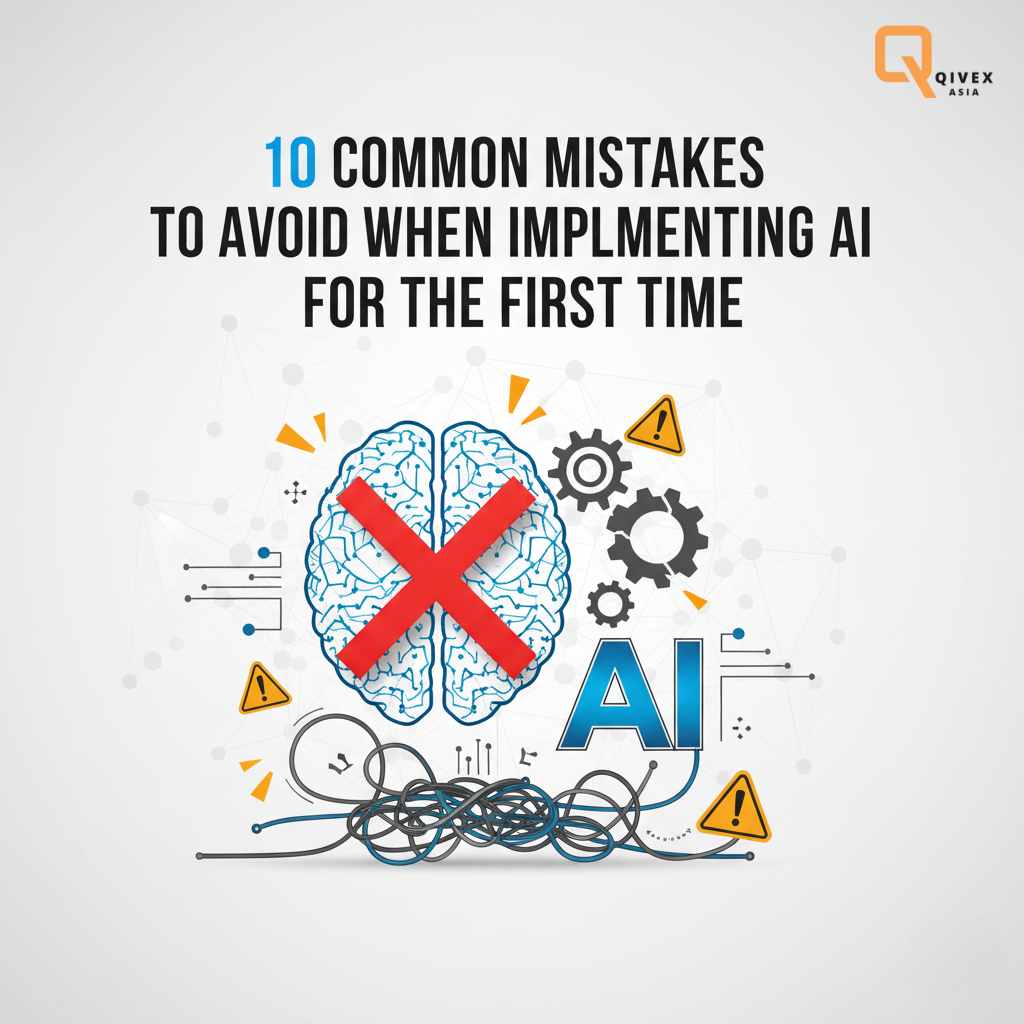
10 Common Mistakes to Avoid: A Step-By-Step Guide
1. Starting Without a Business Problem
The fastest way to fail is to buy tools first and ask why later, so leaders should define a single measurable outcome, such as reducing support resolution time by a precise percentage, and link prompts, access, and telemetry to that KPI from day one. Anchor scope to a few workflows where AI has clear leverage, such as summarization for customer tickets in Microsoft 365, and establish a baseline with time-on-task studies so productivity claims can be verified against the initial state.
Use a stage gate for expansion, moving from a narrow pilot to broader rollouts only when key metrics improve and user behavior data confirms repeatable value, rather than expanding because the demo looked great.
2. Skipping Data Governance
Generative AI amplifies the quality and permissioning of the data it sees, which means poor metadata, missing retention rules, and sloppy access controls can translate into wrong answers and exposure risks at scale. Tie AI deployment to a living data catalog and a permission model that respects least privilege, and audit what Copilot-like systems can access in SharePoint, email, and chats before enabling content-grounded features broadly.
Map and classify sensitive content and ensure that retrieval-augmented generation pulls only from authoritative, up-to-date sources to reduce hallucinations and policy violations.
3. Ignoring Security and Compliance
The Samsung episode showed how fast sensitive code can leak when people use public chatbots without guardrails, which is why enterprises must create safe defaults, private instances, and clear rules before demand explodes.
The EU AI Act’s staged enforcement pressures deployers to track use cases, perform risk mapping, and meet transparency duties for general-purpose AI, so compliance cannot be an afterthought in 2025 rollouts. Adopt NIST’s AI RMF functions, Govern, Map, Measure, and Manage, to embed risk work in normal operations so security and compliance stay aligned with product timelines.
4. Rushing Pilots Into Production
Leaders often move a promising proof of concept into production without setting up observability, drift monitoring, prompt version control, or human-in-the-loop review, which leads to brittle performance in the wild. Gartner’s analysis of the 2024 cycle emphasized AI engineering and operational rigor, which means MLOps, data pipelines, evaluation harnesses, and rollback playbooks must exist before scaling access.
Treat prompts, retrieval chains, and policies as code, ship changes through CI, and require pre-deployment evaluation runs on representative datasets to surface accuracy, bias, and latency issues early.
5. Underinvesting in Change Management
Adoption hinges on training, job-level playbooks, and incentives that reward the right use, because productivity requires behavior change, not just licenses, and leaders need to measure the habits that drive durable gains.
For Copilot-style tools, publish task recipes for roles, run live enablement sessions, and create office hours so users can refine prompts and share templates that link to documented workflows, not just ad hoc hacks.
Track adoption, proficiency, and outcome metrics together, since raw usage without measurable improvements on core KPIs is not value, and plan for reinforcement because early novelty fades without coaching.
6. Believing Vendor ROI at Face Value
Forrester’s Projected Total Economic Impact studies clarify that results come from a composite organization and assumptions, yet organizations often treat projections as guarantees, which distorts budget expectations and timing.
Analysts have also flagged an ROI gap in some deployments, with a Gartner readout noting only a small fraction of organizations see significant realized ROI today, which suggests caution and tighter measurement are prudent. Leaders should build a unit economics model that includes licensing, training, security hardening, and inference usage, then use benchmarks to adjust as empirical telemetry accumulates over quarters, not weeks.
7. Removing Humans From the Loop Too Early
The Air Canada tribunal made clear that companies are responsible for information on their sites, including chatbots, which means a wrong answer can become a legal and brand liability if review and policy checks are missing.
Human-in-the-loop policies help teams catch hallucinations, policy violations, and tone problems before responses reach customers, which reduces downstream cost and complaint volume. Route higher-risk interactions to human review and design escalation paths that preserve context so the handoff is fast and the customer experience improves rather than degrades.
8. Letting Shadow AI Run the Show
Without sanctioned tools and clear guidance, employees will paste code or sensitive notes into public chats, as Samsung, banks, and other firms learned the hard way, which invites data loss and contractual breaches.
Provide a vetted private assistant with logging and policy controls, publish dos and don’ts, and make team leads accountable for reinforcing safe practices, since governance must be social as well as technical. Offer a feedback loop and a safe ask-anything channel so teams do not feel forced to go off-platform to move faster, which curbs risky workarounds.
9. Underestimating the Total Cost of Ownership
Budgets often ignore inference usage patterns, prompt inflation, retrieval complexity, and vendor lock-in, yet these factors can turn initial savings into cost surprises as adoption spreads.
IDC expects AI and gen AI spending to grow rapidly through 2028, which should push leaders to track cost per task and cost per outcome rather than flat per-seat fees, otherwise, spending outruns value. Build policies for caching, model selection by task, and right-sizing context windows, then set budget alarms tied to telemetry so finance sees and steers spend with operations in one rhythm.
10. Skipping Evaluation and Continuous Monitoring
NIST’s AI RMF centers on measuring and managing risk through ongoing evaluation, which includes bias checks, reliability baselines, incident response, and regular model or prompt updates based on real-world drift.
Establish a living evaluation suite with golden sets for key tasks, track accuracy, latency, refusal rates, and safety violations, and publish dashboards leaders can read weekly, not quarterly. When metrics slip, trigger corrective action, such as prompt refactoring, retrieval of source changes, or fine-tuning, and log changes with audit trails that satisfy internal policy and external regulators.
People of Interest or Benefits
Satya Nadella, Microsoft
Satya Nadella framed the moment as an “age of copilots,” arguing that assistants will become a ubiquitous interface that runs across devices and contexts, which crystallizes Microsoft’s bet that Copilot will reshape knowledge work rather than sit as an optional add-on.
He has repeatedly positioned Copilot as a new era of personal computing, a claim that energizes adopters but also raises the bar on realized value, security, and trust once pilots meet production and auditors ask for proof of outcomes and controls.
The strategic message is clear: copilots should feel present wherever work happens, and that vision pressures organizations to clean up data, permissions, and workflow definitions so the assistant can act on high-quality, authorized content without spraying sensitive information into the wrong places.
That alignment plays directly into the mistakes above, since a ubiquitous assistant magnifies both the benefits of good governance and the costs of skipping it, especially under the EU AI Act clock and customers’ rising expectations for accurate answers and safe automation.
A Legal Wake-up Call, Air Canada
The British Columbia Civil Resolution Tribunal held Air Canada liable for negligent misrepresentation after a website chatbot gave misleading advice about bereavement fares, awarding damages and clarifying that companies remain responsible for information presented by their automated agents, not just static pages, a point that resonates across sectors deploying AI into customer journeys.
Reporting on the case highlights that the tribunal rejected arguments that customers should have double-checked other pages, signaling that internal consistency and governance across channels, human or AI-driven, is a baseline duty, not a nice-to-have. This case, alongside ongoing regulator focus, sends a simple message, if automation touches customers, put human review, escalation, and accurate source grounding in place or risk legal, reputational, and compliance fallout that swamps any early time-savings.
For AI teams and general counsel, the operational takeaway is to tie design to policy, snapshot interactions, and document testing and monitoring, because in the courtroom and the boardroom, process and evidence matter as much as the model’s cleverness.
Looking Ahead
Analysts now predict AI spending will accelerate through 2028, with IDC projecting worldwide AI outlays reaching hundreds of billions and a growing share tied to generative AI, which shifts the executive agenda from trials to durable operating models with budgets, telemetry, and governance baked in.
The EU AI Act’s compliance timeline forces clarity on inventory, risk classification, transparency for general-purpose AI, and controls on prohibited uses, so 2025 will reward organizations that embrace frameworks like NIST’s AI RMF and management standards such as ISO/IEC 42001 to standardize responsible deployment at scale.
Expect productivity platforms to push deeper assistant integration while buyers ask sharper ROI questions, since projected gains will need to show up in cost per outcome, time-to-resolution, and revenue motion improvements that finance, security, and compliance can all validate together. Here’s the rub: this smells like a consolidation phase where fewer, better-governed use cases expand steadily as leaders prove value and safety, rather than a frenzy of experiments that never harden into reliable, measured, and compliant operations.
Closing Thought
If copilots become as ubiquitous as their champions predict, will governance-first operators quietly outcompete hype-first rivals as courts, regulators, and customers reward AI that is accurate, auditable, and actually useful in the flow of work?