



Reader Disclosure
This content is created for educational and informational purposes only. It does not constitute financial, legal, or professional medical advice. While we strive for accuracy in the rapidly evolving fields of DeSci and AI, readers should conduct their own research before making decisions based on this information.
The comprehensive glossary below decodes how today’s privacy rules collide with shifting ad tech realities and rising AI risks, so leaders can make faster, safer decisions anchored in current facts and enforcement trends. Amid a 9 percent drop in global breach costs, persistent GDPR fines, and Google’s cookie choice policy, privacy literacy has become a competitive moat for investors, operators, and teams navigating real risk and growth.
Global breach costs fell to an average of 4.44 million dollars in 2025, down from 4.88 million dollars in 2024, even as U.S. breach costs hit a record 10.22 million dollars and regulators kept pressure on noncompliance across regions.
At the same time, the GDPR fine tally crossed roughly 5.88 billion euros since 2018, and Google confirmed that Chrome will maintain third-party cookie choice, reshaping measurement and targeting while regulators and publishers watch closely.
This turns privacy terms into operating levers for investors seeking resilience, marketers facing signal loss, and employees tasked with data stewardship under both AI and tracking scrutiny, which is exactly why a practical glossary is overdue.
After peaking on hype, privacy now runs on hard constraints and measurable risk reduction, as AI-driven security tools shorten breach lifecycles while GDPR enforcers and Chrome’s cookie choice force brands toward first-party data, PETs, and strong governance.
Here is the thing: the winners will fuse clear legal definitions with NIST’s risk-based playbook and EU AI Act timelines, because this mix best aligns product, marketing and compliance with what customers and regulators actually expect in 2025.
Key Data
-
The global average cost of a data breach declined 9 percent to 4.44 million dollars in 2025, while the U.S. rose to 10.22 million dollars, widening the compliance and risk gap across markets.
-
GDPR fines total about 5.88 billion euros since 2018, with 1.2 billion euros imposed in 2024 alone, underscoring ongoing enforcement momentum even as yearly totals fluctuate.
-
Data protection and privacy laws are now in force in 144 countries, expanding compliance scope and complicating cross-border operations for all sectors.
Why the Data Matters for This Glossary
These figures show privacy risk is quantifiable and shifting, so every definition in this glossary maps to actions that reduce breach costs, survive enforcement and preserve addressability in a post-cookie choice world.
Organizations that link terms like controller, DPIA, and privacy by design to programmatic controls from NIST’s Privacy Framework can cut dwell time, accelerate containment, and justify investments to stakeholders with clearer metrics and governance.
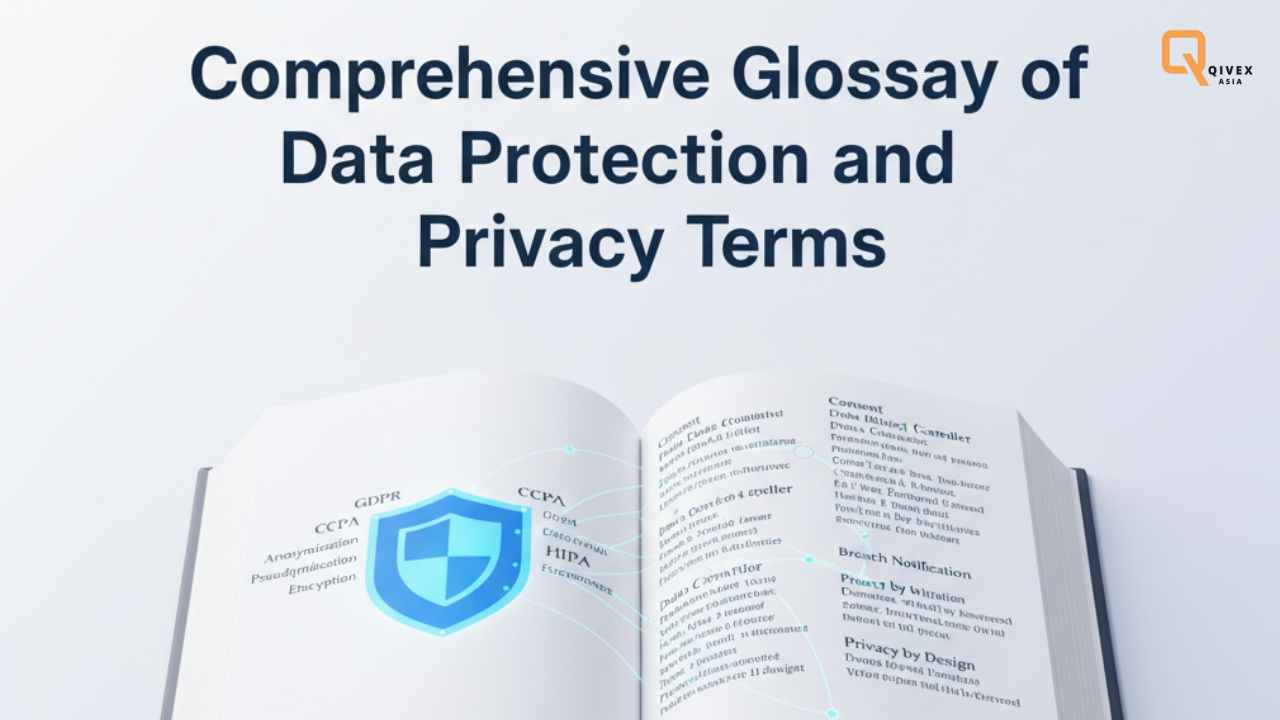
Comprehensive Glossary Of Data Protection And Privacy Terms: Step-by-Step Guide

1. Core Concepts: Personal Data, Special Category Data, Processing
-
Personal data is any information relating to an identified or identifiable person, and processing includes any operation on that data, such as collection, storage, or disclosure, which makes the scope of compliance much broader than just databases.
-
Special category data covers sensitive fields like health or biometrics requiring stronger safeguards, while any automated or manual handling of such data triggers principles and rights obligations from the outset.
-
In practice, mapping data flows against this expansive processing definition is step one, because missed flows are where incidents, fines, and costly remediation usually start.
2. Roles: Controller, Processor, DPO
-
A controller decides the purposes and means of processing, while a processor acts on behalf of the controller, and getting this split wrong leads to contract gaps that surface during audits or breaches.
-
Contracts with processors must set obligations, security measures, and sub-processing controls, which reduce ambiguity when supply chain incidents or regulatory questions arise.
-
A Data Protection Officer, where required, centralizes oversight and advice, aligning product, security, and legal with ongoing monitoring and reporting obligations that regulators expect to see.
3. Principles and Lawful Bases
-
The GDPR’s principles require lawfulness, fairness, transparency, purpose limitation, data minimization, accuracy, storage limitation, integrity and confidentiality, and accountability, which together determine how systems should be designed and documented.
-
Lawful bases include consent, contract, legal obligation, vital interests, public task, and legitimate interests, and choosing the wrong basis is a common root cause for fines citing insufficient legal basis.
-
Here is the thing: legitimate interests can be useful yet risky, so teams should document balancing tests and fallback strategies in case regulators or partners dispute the legal theory behind a use case.
4. DPIA and Privacy by Design
-
A Data Protection Impact Assessment is mandatory for high-risk processing and should describe processing, assess necessity and proportionality, and manage risks with concrete measures before launch.
-
Criteria from European guidance flag triggers like systematic monitoring, sensitive data at scale, automated decisions, and vulnerable subjects, so meeting even two triggers often means a DPIA is needed.
-
Privacy by design requires embedding controls at architecture time, which in practice means integrating DPIA outcomes into product backlogs, security testing, and vendor reviews rather than treating privacy as a policy document.
5. Rights and Cross-Border Transfers
-
Data subject rights include access, rectification, erasure, portability, and objection, which forces teams to engineer retrieval, deletion, and export workflows upfront to avoid manual, error-prone responses at scale.
-
Cross-border transfers require safeguards under Chapter V, so controllers must evaluate legal mechanisms and risk, especially where enforcement and public authority access questions remain live.
-
Look, treating rights and transfers as product features rather than tickets is how organizations cut response times and demonstrate accountability in audits and incident reviews.
6. Pseudonymization, Anonymization, and Pets
-
Pseudonymization reduces linkability by processing data so it cannot be attributed to a person without additional information kept separately, while anonymization aims to irreversibly prevent identification, which is hard in practice.
-
Teams increasingly use privacy-enhancing technologies like differential privacy, secure enclaves, and homomorphic encryption to balance utility with protection, aligning with modern frameworks and regulator expectations.
-
The NIST Privacy Framework’s structure helps place PETs within risk decisions instead of pilots that never scale, by tying controls to outcomes and governance tiers.
7. NIST Privacy Framework and Governance
-
NIST’s Privacy Framework is a voluntary tool aligned with the Cybersecurity Framework that organizes privacy activities into Core, Profiles and Implementation Tiers for practical deployment.
-
The 2025 update aligns with CSF 2.0 and introduces guidance on AI privacy risk management, which simplifies pairing security and privacy roadmaps in one governance model.
-
For executives, a shared structure is how budgets flow to the right controls and how teams show measurable risk reduction to boards and auditors who want comparable metrics.
8. AI systems and the EU AI Act
-
The EU AI Act took effect in 2024 with staged obligations through 2025 to 2027, including immediate bans on unacceptable risk systems and governance duties for GPAI and high-risk operators on a set timeline.
-
Key dates include August 2025 governance rules and GPAI duties, August 2026 high-risk obligations, and August 2027 full applicability for remaining operators, which overlaps with GDPR duties on data quality, transparency, and rights.
-
Privacy teams will need joint registers and reviews so AI risk classification, data lineage, and lawful bases align, because divergence will be visible to authorities and partners, sources say.
9. Third-Party Cookies, First-Party Data, and Measurement
-
In April 2025, Google said Chrome will maintain third-party cookie choice and will not roll out a standalone prompt, shifting emphasis toward first-party data, contextual targeting, and Privacy Sandbox APIs.
-
The UK CMA noted the change while continuing oversight of Privacy Sandbox, signaling that antitrust and privacy guardrails will co-shape tracking protections and industry roadmaps.
-
For marketers, this smells like a dual-stack era where cookie-reliant paths continue while privacy-preserving APIs grow, requiring testing plans, consent UX improvements, and direct data value exchanges.
10. Standards and Certifications
-
ISO IEC 27701 provides a structured framework for a Privacy Information Management System that extends or aligns with security standards and helps demonstrate accountability to regulators and partners.
-
Industry watchers expect a 2025 evolution that increases flexibility for certification and implementation, reinforcing privacy program maturity and audit readiness across diverse environments.
-
Standards are not a silver bullet, but they reduce variance, enable repeatable processes, and make vendor oversight more defensible in a world of complex supply chains.
People of Interest or Benefits
Expert View: Julie Chua, NIST
NIST updated its Privacy Framework to better align with CSF 2.0 and address AI-related privacy risk, and Julie Chua called it a modest but significant update intended to help organizations manage the full spectrum of privacy and cybersecurity risks together. That matters because privacy controls too often sit in siloed playbooks separate from real-world security operations, which makes budgets harder to justify and response times slower during breaches or regulator inquiries.
Leaders can use the new guidance to tie PETs, consent, and data minimization into the same planning cadence as identity, detection, and incident response, which is where savings and faster containment actually show up in the numbers. Here is the thing: when frameworks talk to each other, auditors, insurers, and go-to-market partners start speaking a common language that reduces deal friction, especially across multiple jurisdictions.
Industry View: Chloe Nicholls, IAB UK
Reacting to Google’s decision, IAB UK’s Head of Ad Tech said third-party cookies will remain on Chrome and that while it is a significant change, marketers should keep pushing privacy-preserving tactics like first-party and contextual strategies. This clarity ends the stop-start cycle that has stalled some measurement pilots, but it also requires leaders to manage two realities at once, which makes governance and experimentation discipline even more important.
Publishers that invest in consent value, identity partnerships, and Sandbox testing will likely outperform those waiting for a single switch-off date that is not coming soon, according to continued CMA oversight signals. In short, operational optionality beats perfect roadmaps when the browser, regulator, and partner ecosystem all move at different speeds, and that is now the default setting for digital media.
Looking Ahead
Privacy and AI Governance Collide From 2025 to 2027
Analysts now predict privacy programs will merge with AI governance as the EU AI Act duties phase in by August 2025 for GPAI providers and escalate through 2026 for high-risk operators, which will increase demand for combined risk registers and audit evidence. Expect procurement and data teams to unify vendor and model inventories so data lineage, lawful basis, and risk classification stay consistent, because fragmented records will trigger delays and findings during reviews or incidents.
Organizations that prototype privacy impact questions inside AI model cards and red team exercises will likely reduce both regulatory exposure and breach response time in the next cycle. Look, the companies that practice together will report lower dwell time and fewer fines, which is where investor confidence and customer trust come from in a skeptical market.
Advertising, consent, and measurement in the cookie choice era. With Chrome maintaining third-party cookie choice, the ad ecosystem enters a dual track period where first-party data strategies, contextual relevance, and Privacy Sandbox APIs operate alongside legacy approaches under CMA scrutiny. Marketers can de risk by instrumenting consent UX, building clean room partnerships, and validating Sandbox performance attribution, because waiting invites signal erosion without learning.
Regulators will continue to challenge dark patterns and insufficient legal bases, so lawful basis hygiene and transparent notices remain non-negotiable, particularly for cross-border campaigns. If teams align measurement, privacy engineering, and commercial goals, they can hit performance targets while staying inside the lines, which is becoming a key differentiator as fines and breach headlines remain steady.
Closing Thought
If privacy is now a product feature and AI risk is a board metric, will Google’s cookie choice era and the EU AI Act finally force a true merger of marketing, security and legal into one operating plan, or will fragmented playbooks keep costs and fines stubbornly high?