


Reader Disclosure
This content is created for educational and informational purposes only. It does not constitute financial, legal, or professional medical advice. While we strive for accuracy in the rapidly evolving fields of DeSci and AI, readers should conduct their own research before making decisions based on this information.
How AI Detects Cyber Attacks in Real Time (2026 Guide)
Cyber attacks no longer creep slowly through a system. They arrive fast, sometimes within seconds, and they rarely follow predictable patterns. Security teams once depended on manual reviews and fixed detection rules. That approach worked when threats changed slowly. Today, it struggles to keep up.
Artificial intelligence has stepped into that gap. AI systems watch network activity continuously, learning what normal behavior looks like across devices, users, and applications. When something unusual appears, the system reacts immediately. Not hours later. Not after a breach.
Understanding how this actually works requires looking beneath the marketing language. AI detection relies on pattern recognition, behavior analysis, and constant learning from data. When these pieces work together, organizations gain something close to real-time visibility into threats moving through their networks.
This article explains how AI detects cyber attacks in real time, why it works better than older security tools, and where the technology still faces limits.
Understanding Real-Time Cyber Threat Detection

Real-time threat detection refers to the ability to identify malicious activity while it is happening, not after the damage has already begun. Security tools monitor events such as login attempts, file transfers, system calls, and network traffic. AI analyzes these signals continuously and decides whether the behavior looks normal or suspicious.
Traditional security systems relied mostly on known attack signatures. If malware matched a pattern stored in a database, the system blocked it. If the attack looked new or slightly modified, it could slip past unnoticed. AI approaches the problem differently. It studies behavior instead of just known fingerprints.
Modern AI security platforms analyze massive streams of security data and look for deviations from expected patterns. When the system notices something unusual, it triggers an alert or automatically responds.
Why Speed Matters in Cybersecurity
The speed of modern cyber attacks has changed dramatically. In many cases, attackers move through networks within minutes. Some breaches begin with data theft only seconds after the initial entry point.
When detection takes hours, the attacker already has control. Real-time monitoring closes that window. AI systems scan activity continuously and compare events against models trained on normal network behavior.
This constant monitoring reduces what security professionals call attacker dwell time. In simple terms, the less time an attacker spends undetected, the less damage they can cause.
The Core Technologies Behind AI Cyber Attack Detection
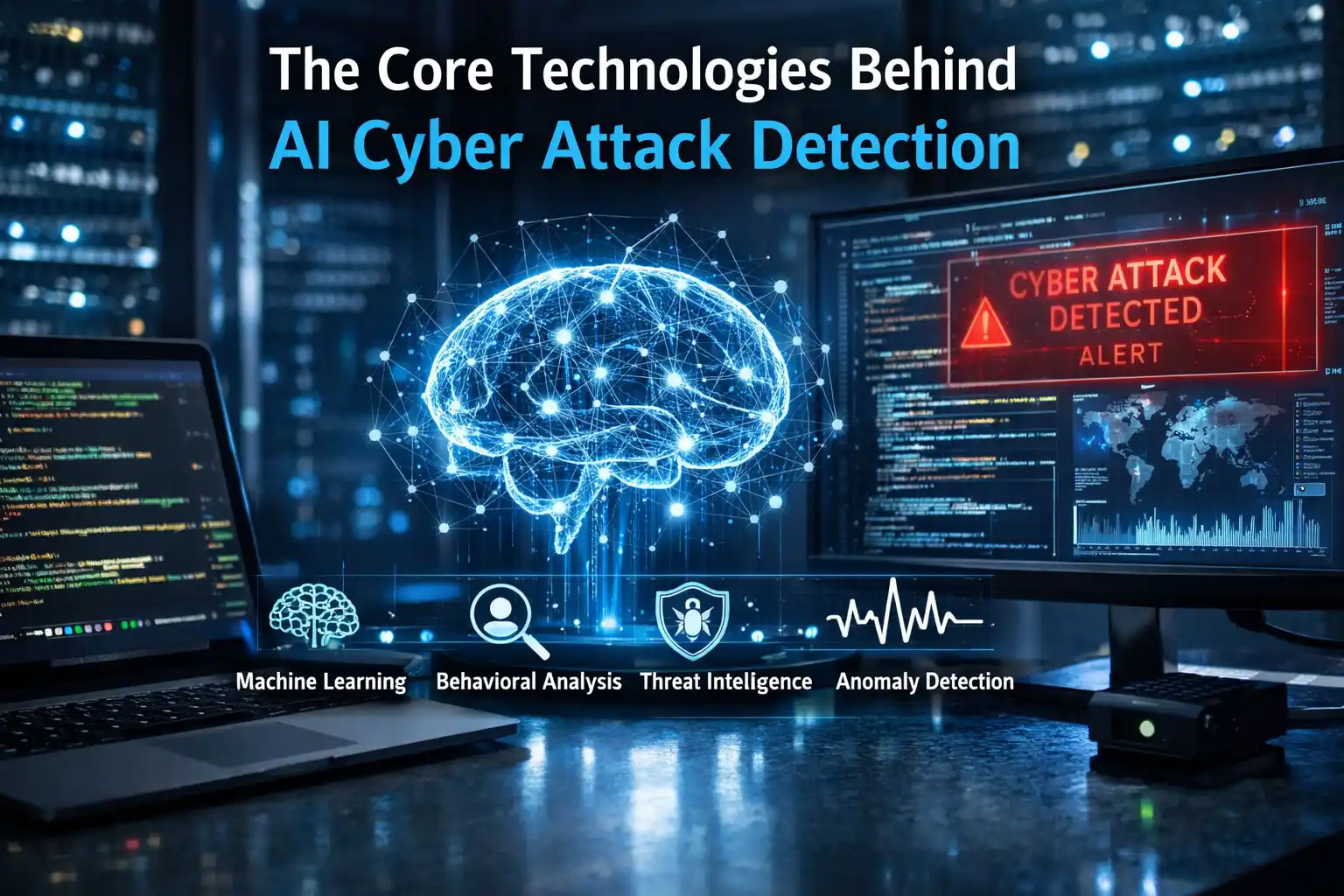
Artificial intelligence in cybersecurity is not a single technology. It is a collection of methods that work together to interpret large volumes of security data.
Machine Learning
Machine learning forms the backbone of many AI security platforms. These algorithms analyze historical data and learn patterns that represent normal system behavior. Once the model understands typical activity, it can detect abnormal events.
For example, a machine learning model may learn that employees usually log in from certain locations during working hours. If a login suddenly appears from another country at midnight, the system flags it as suspicious.
Over time, the model improves as it processes new information.
Deep Learning
Deep learning systems rely on neural networks that can analyze complex relationships in large datasets. These models are useful for detecting sophisticated attacks that involve many subtle signals.
In cybersecurity environments, deep learning models can analyze network traffic, malware behavior, and user activity simultaneously. The goal is to identify patterns that humans might overlook.
Natural Language Processing
Some cyber attacks arrive through text-based channels such as phishing emails or fraudulent messages. Natural language processing helps AI analyze language patterns, detect malicious intent, and identify impersonation attempts.
These systems examine email content, sender metadata, and attachment behavior to detect phishing campaigns and social engineering tactics.
How AI Detects Cyber Attacks Step by Step

The real-time detection process usually follows a sequence of stages. While every platform works slightly differently, most systems share a similar architecture.
Data Collection
The process begins with data. AI security platforms collect information from many sources inside an organization.
- Network traffic logs
- User authentication records
- Endpoint device activity
- Application logs
- Cloud service events
This data provides the raw material for AI analysis. Without large data streams, the system cannot learn meaningful patterns.
Behavioral Modeling
Once the system gathers enough data, it builds models describing normal behavior across the network.
For example, the system may learn patterns such as:
- Typical login locations
- Normal file access behavior
- Standard network traffic volumes
- Expected system processes
This stage often takes time. The system must observe activity long enough to form a reliable baseline.
Anomaly Detection
When a new activity occurs, the AI compares it to the baseline model. If the behavior deviates significantly from the expected pattern, the system marks it as an anomaly.
Anomalies do not always mean attacks. Sometimes they reflect harmless changes such as a new software installation. But unusual behavior is often the first signal of malicious activity.
AI systems evaluate the anomaly and determine the level of risk.
Threat Classification
After detecting suspicious behavior, the AI attempts to classify the threat. It examines characteristics such as:
- Command sequences
- Network destinations
- Malware signatures
- User behavior anomalies
This analysis helps determine whether the event represents ransomware, data exfiltration, insider misuse, or another attack category.
Automated Response
Many modern platforms include automated response capabilities. When the system confirms a threat, it can take immediate action.
Possible responses include isolating an infected device, blocking suspicious network connections, or forcing a password reset.
Automation reduces response time dramatically. Instead of waiting for analysts to investigate manually, the system acts within seconds.
The Role of Behavioral Analytics in Threat Detection
One of the most important changes AI introduced to cybersecurity is behavior-based detection.
Traditional systems looked for known attack signatures. Behavioral analytics looks for abnormal activity instead.
The system monitors how users and devices behave over time. If something changes suddenly, the AI treats it as a potential threat.
Examples include:
- A user is downloading large volumes of sensitive files unexpectedly
- A server communicating with unfamiliar external systems
- An employee account accessing systems outside of normal job functions
Behavior-based detection can identify threats that do not match known malware signatures. This makes it especially useful for detecting zero-day attacks and insider threats.
Detecting Different Types of Cyber Attacks with AI

Artificial intelligence can identify a wide range of threats. Each attack type leaves different signals inside the network.
Phishing and Social Engineering
AI email security systems analyze message content, sender behavior, and attachment activity. If the system detects suspicious language patterns or impersonation attempts, it blocks the message before it reaches the user.
Malware and Ransomware
AI models examine how programs behave inside a system. Malware often performs unusual actions such as encrypting files rapidly or attempting unauthorized system access.
The system detects these patterns and stops the process.
Network Intrusions
Network monitoring tools analyze traffic flows between devices. When the system detects unusual communication patterns, it may indicate an attacker moving laterally through the network.
Insider Threats
Not all attacks come from outside. Sometimes employees misuse access privileges intentionally or accidentally.
AI systems monitor behavior patterns and identify unusual actions that might signal insider risk.
Real World Applications of AI Cyber Attack Detection
Organizations across many industries rely on AI-based security systems.
Banking and Financial Services
Financial institutions use AI to monitor transactions and account access in real time. If the system detects unusual transaction behavior, it can freeze activity instantly to prevent fraud.
Healthcare Systems
Hospitals manage large volumes of sensitive patient data. AI tools monitor network activity and detect phishing attempts targeting medical staff.
Cloud Infrastructure Security
Modern organizations rely heavily on cloud platforms. AI security tools analyze cloud workloads, container activity, and API interactions to detect suspicious behavior across distributed environments.
Why AI Detects Cyber Attacks Faster Than Humans
Human analysts remain essential in cybersecurity. Still, AI handles certain tasks far more efficiently.
AI systems analyze enormous volumes of data simultaneously. A single enterprise network may generate millions of security events each day. Humans cannot review that volume manually.
Machine learning models process these events instantly. They identify correlations across datasets and detect subtle anomalies that might otherwise remain hidden.
AI also works continuously. It does not require sleep, shifts, or breaks. This constant monitoring helps detect attacks as they emerge.
Challenges and Limitations of AI Cybersecurity Systems
Despite its advantages, AI detection systems are not perfect.
False Positives
AI systems sometimes flag normal behavior as suspicious. These false alarms can overwhelm security teams if not managed carefully.
Improving model accuracy requires careful tuning and continuous training.
Data Quality Issues
AI depends heavily on data quality. If the system receives incomplete or biased data, the resulting model may misinterpret normal activity.
Organizations must maintain accurate logging systems and consistent monitoring infrastructure.
Explainability Problems
Many AI models operate as complex black boxes. Security analysts may find it difficult to understand why the system labeled certain behavior as malicious.
Researchers continue exploring explainable AI techniques that make model decisions easier to interpret.
The Future of Real-Time AI Threat Detection
Cybersecurity experts expect AI to become even more integrated into security operations over the next decade.
Several trends already point in that direction.
Security systems increasingly combine AI with automated response tools. These platforms not only detect attacks but also neutralize them immediately.
Threat intelligence systems are also expanding. They gather data from external sources such as dark web forums, vulnerability databases, and malware repositories.
By combining external intelligence with internal monitoring, AI platforms can predict attacks before they reach an organization.
Researchers are also developing lightweight AI models designed for edge devices and distributed networks. These systems analyze threats directly on devices with limited computing resources while maintaining high detection accuracy.
Frequently Asked Questions About AI Detecting Cyber Attacks
How does AI detect cyber attacks in real time?
AI systems monitor network activity continuously and compare it against learned behavioral patterns. When the system identifies abnormal activity, it triggers alerts or automated responses to stop potential threats.
What types of cyber attacks can AI detect?
AI security tools can detect malware infections, phishing campaigns, ransomware activity, network intrusions, and insider threats. The system identifies unusual patterns across user behavior, network traffic, and application activity.
Can AI completely replace human cybersecurity analysts?
No. AI assists analysts by identifying threats faster and analyzing large volumes of data. Human experts still investigate incidents, refine detection rules, and make strategic security decisions.
Is AI-based cybersecurity always accurate?
AI detection systems improve security significantly, but they can still generate false alerts or miss subtle threats. Continuous training and human oversight remain important.
Conclusion
Cybersecurity once depended mostly on rules written by human experts. That model worked in a slower digital world. Today, attackers move at machine speed and constantly change their methods.
Artificial intelligence shifts the balance. Instead of waiting for known attack signatures, AI studies behavior across networks, devices, and users. When activity drifts away from normal patterns, the system reacts almost immediately.
That speed matters. Detecting an attack within seconds rather than hours can prevent massive data breaches and financial loss.
Still, AI should not be viewed as a complete solution. Effective cybersecurity blends machine intelligence with human expertise. Analysts interpret alerts, investigate incidents, and guide the systems that watch over digital infrastructure.
When these pieces work together, organizations gain something that once seemed impossible: the ability to see cyber attacks as they unfold and stop them before they spread.
Author Recommendation
Cybersecurity discussions often swing between hype and skepticism. Artificial intelligence sits right in the middle of that debate. Some articles describe it as a miracle solution, while others dismiss it as overpromised technology. The reality appears more nuanced.
AI detection tools have clearly improved the speed of threat discovery. Systems now analyze huge streams of network data and identify unusual behavior far faster than manual monitoring ever could. For organizations dealing with millions of daily events, this capability changes the entire security workflow.
At the same time, relying on automation alone would be risky. Attackers constantly adapt their techniques, and AI models can misinterpret unfamiliar activity. Skilled security professionals still play a central role in interpreting alerts, investigating incidents, and shaping defensive strategies.
Readers exploring AI cybersecurity tools should focus on practical outcomes rather than marketing claims. Look closely at detection accuracy, transparency of the model, and integration with existing security systems. Technology works best when it fits naturally into the broader security architecture rather than replacing it entirely.
In short, AI does not eliminate cyber risk. What it does offer is speed, scale, and insight. Used carefully, it becomes a powerful partner for security teams trying to keep pace with an increasingly aggressive threat landscape.