



Reader Disclosure
This content is created for educational and informational purposes only. It does not constitute financial, legal, or professional medical advice. While we strive for accuracy in the rapidly evolving fields of DeSci and AI, readers should conduct their own research before making decisions based on this information.
Traditional Science vs DeSci: Some Key Differences You Need to Know in 2026
Science has never followed a single path. Over centuries, research systems slowly formed around universities, laboratories, journals, and grant agencies. That structure still drives most discoveries today. Vaccines, particle physics, and climate research. Nearly all of it flows through what scholars often call traditional science, sometimes shortened to TradSci.
Yet a different idea has begun circulating in research circles. Some technologists and scientists argue that the current model moves too slowly, concentrates authority in a few institutions, and limits access to knowledge. Their answer is Decentralized Science, usually called DeSci.
This concept rests on blockchain networks, open collaboration tools, and new funding models that rely less on central institutions. The idea may sound radical at first glance. Still, a closer look shows that DeSci does not try to erase traditional science. Instead, it questions how research gets funded, published, and shared.
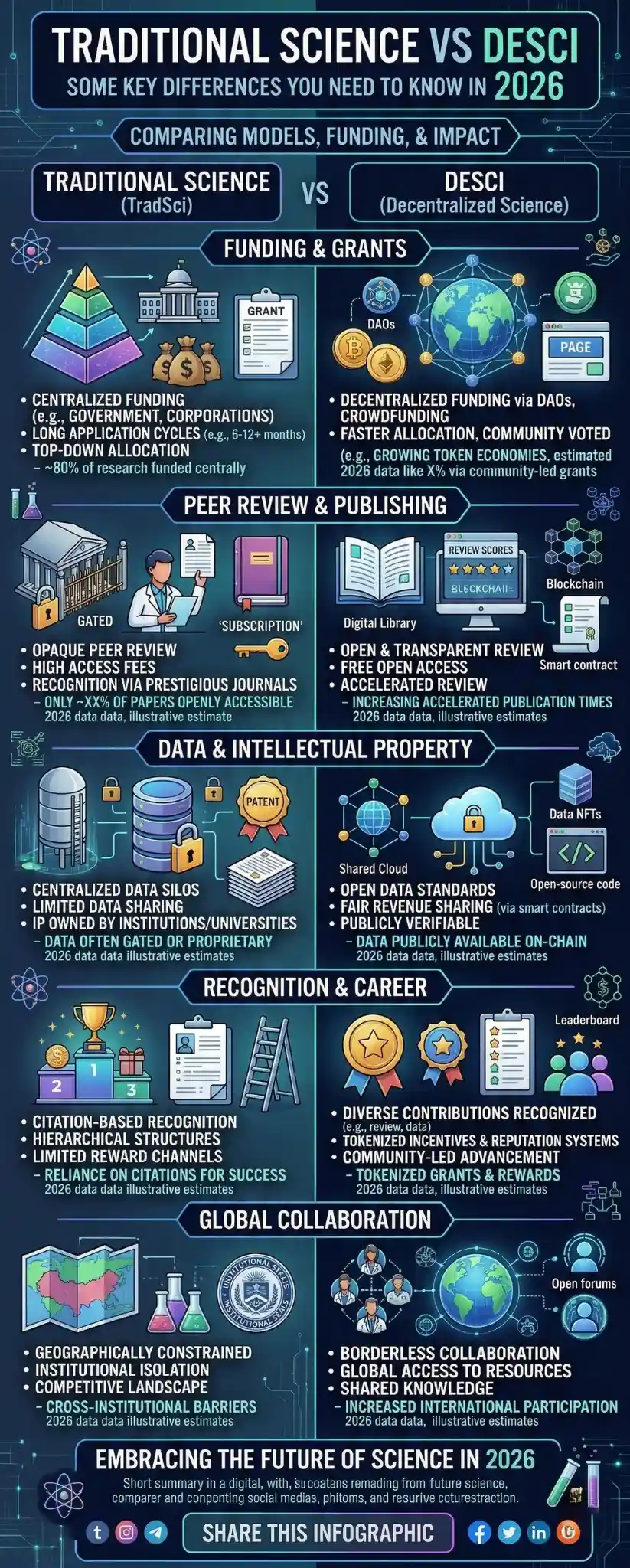
The comparison between these two systems reveals deeper questions about who guides scientific discovery and how knowledge spreads across the world.
Understanding Traditional Science

The Institutional Backbone of Modern Research
Traditional science operates through a network of established organizations. Universities conduct most academic work. Governments distribute grants through national research councils. Journals publish findings after peer review. Philanthropic foundations sometimes step in to fund specialized topics.
This structure has produced remarkable achievements. The mapping of the human genome, advances in cancer therapies, and breakthroughs in astrophysics all emerged within this framework.
The system, however, was developed long before digital networks reshaped global communication. As a result, its processes often remain slow and layered with bureaucracy. Researchers may spend months preparing grant proposals before committees evaluate them. Funding decisions typically pass through several rounds of review.
These steps aim to protect quality. Yet they can also delay progress.
How Funding Works in Traditional Research
Funding stands at the center of the traditional research model. Most projects depend on competitive grants from government agencies, universities, or private foundations.
Panels of experts evaluate proposals. They examine methodology, potential impact, and institutional affiliation. Only a small percentage of submissions receive funding. In many fields, the success rate falls below twenty percent.
Such competition creates pressure. Scientists must balance time between research and grant writing. Early career researchers often struggle to secure support, especially if their ideas challenge existing assumptions.
Still, supporters of the traditional model argue that careful review helps protect scientific standards. Without it, weak or misleading research could easily attract attention.
Publication and Access in the Conventional System
Once a study finishes, the next step usually involves journal publication. Researchers submit manuscripts to academic journals where reviewers examine the work anonymously. If the editors approve it, the article enters the scientific record.
This process has long served as a quality filter. Yet it also introduces limitations.
Many journals require expensive subscriptions. Universities often pay large fees to access articles. Independent researchers or institutions with limited resources sometimes face barriers when trying to read new studies.
Critics say this system slows the spread of knowledge. Supporters respond that peer review and editorial oversight maintain reliability.
What Is DeSci?

The Emergence of Decentralized Science
Decentralized Science represents a growing effort to rethink how research functions. It combines blockchain technology, Web3 infrastructure, and community-driven funding to reshape scientific collaboration.
Instead of relying on centralized institutions, DeSci platforms distribute decision-making across digital networks. Researchers, donors, and community members may participate in funding and governance through blockchain-based systems.
The movement gained traction in the early 2020s as scientists began exploring whether decentralized technology could address persistent issues in research funding and publishing.
Although still experimental, the idea has attracted attention from academic groups, blockchain developers, and patient advocacy organizations interested in accelerating research.
Core Technologies Behind DeSci
DeSci relies on several technological building blocks.
Blockchain ledgers record transactions and data in a distributed network where entries become difficult to alter once confirmed. This structure allows funding flows, research contributions, and data records to remain visible and verifiable.
Smart contracts operate as automated agreements written in code. When certain conditions occur, the contract executes automatically. In research contexts, smart contracts can release funding when milestones are met or manage intellectual property rights.
Another component involves Decentralized Autonomous Organizations, often called DAOs. These digital organizations allow participants to vote on proposals and allocate funds through token-based governance systems.
Together, these tools attempt to create an open research ecosystem that operates without a central authority.
The Structural Differences Between Traditional Science and DeSci
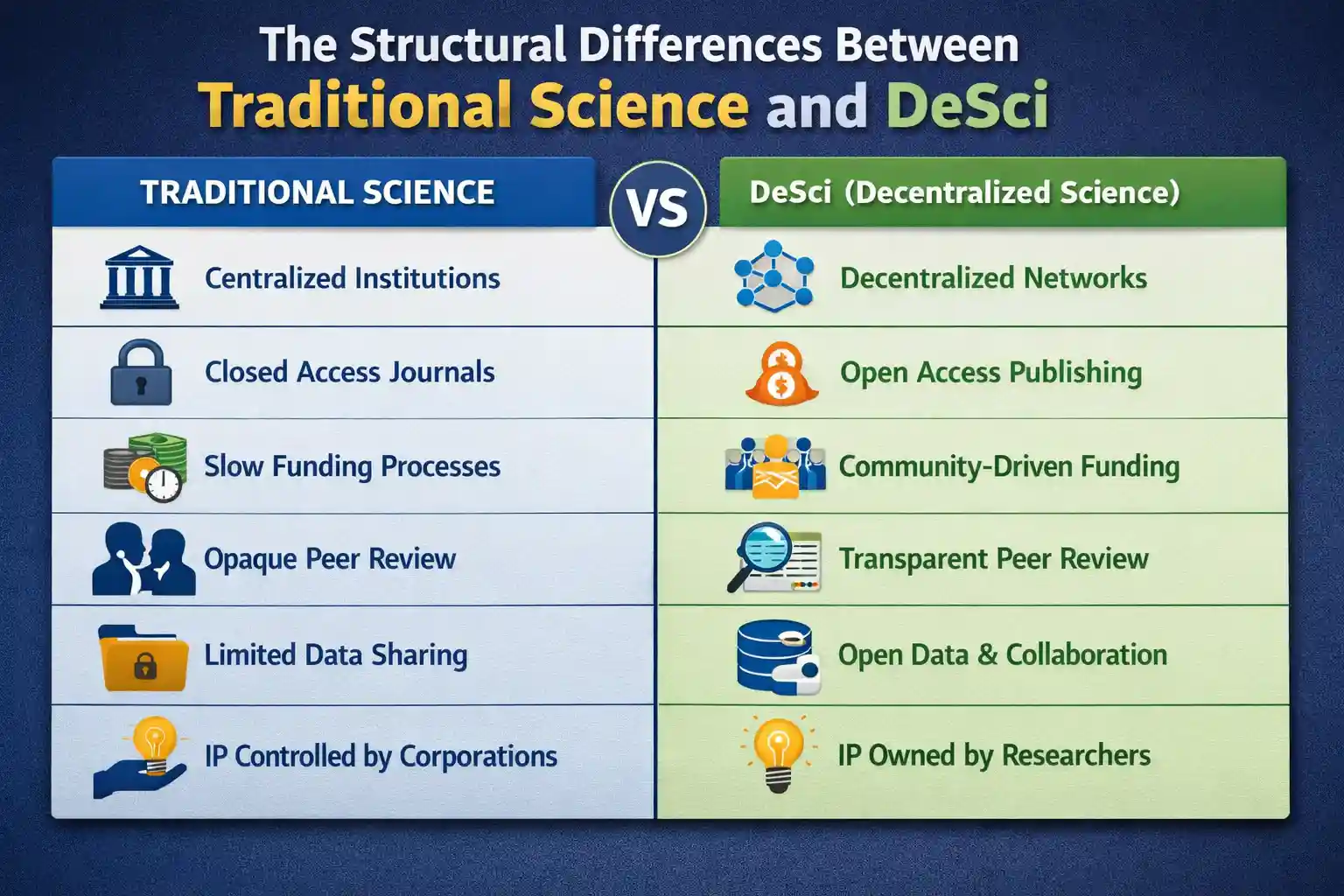
Control and Decision Making
Traditional science concentrates authority in established institutions. Universities, funding agencies, and journal editors guide many of the decisions that shape research agendas.
DeSci moves in the opposite direction. Blockchain platforms distribute authority across networks of participants. Researchers, investors, and community members may propose projects and vote on funding decisions.
This change could broaden participation in scientific governance. At the same time, it raises questions about expertise. Scientific evaluation requires deep knowledge, and open voting systems must still find ways to preserve rigorous standards.
Funding Mechanisms
Traditional funding typically flows from centralized sources such as government agencies or large foundations. Committees review proposals and award grants after careful evaluation.
DeSci introduces alternative models. Communities can fund projects directly through blockchain platforms. Some systems use token-based incentives or quadratic funding, where many small contributions collectively support research.
Because these systems operate on public ledgers, donors can track how funds move through a project.
This transparency appeals to supporters who worry about opaque grant processes in traditional institutions.
Access to Scientific Knowledge
The two systems also differ in how they handle information.
Traditional journals often restrict access through subscriptions or paywalls. Universities pay significant fees to provide students and faculty with journal access.
DeSci platforms usually favor open access. Research data, publications, and experimental protocols may appear on decentralized storage networks where anyone can read them.
Advocates believe this openness could speed collaboration and reduce knowledge barriers across regions.
Yet open systems also face challenges in maintaining quality control and preventing misinformation.
Collaboration Models
Traditional research collaboration often develops through institutional partnerships or professional networks. Scientists usually work within laboratories tied to universities or research institutes.
DeSci platforms attempt to create global research communities that operate online. Scientists from different countries can contribute data, analysis, or funding through decentralized platforms.
This model may encourage interdisciplinary work that might otherwise remain fragmented across institutions.
Still, digital collaboration alone cannot replace the physical infrastructure required for many types of research, such as biomedical experiments or particle physics.
Why Some Researchers Support DeSci
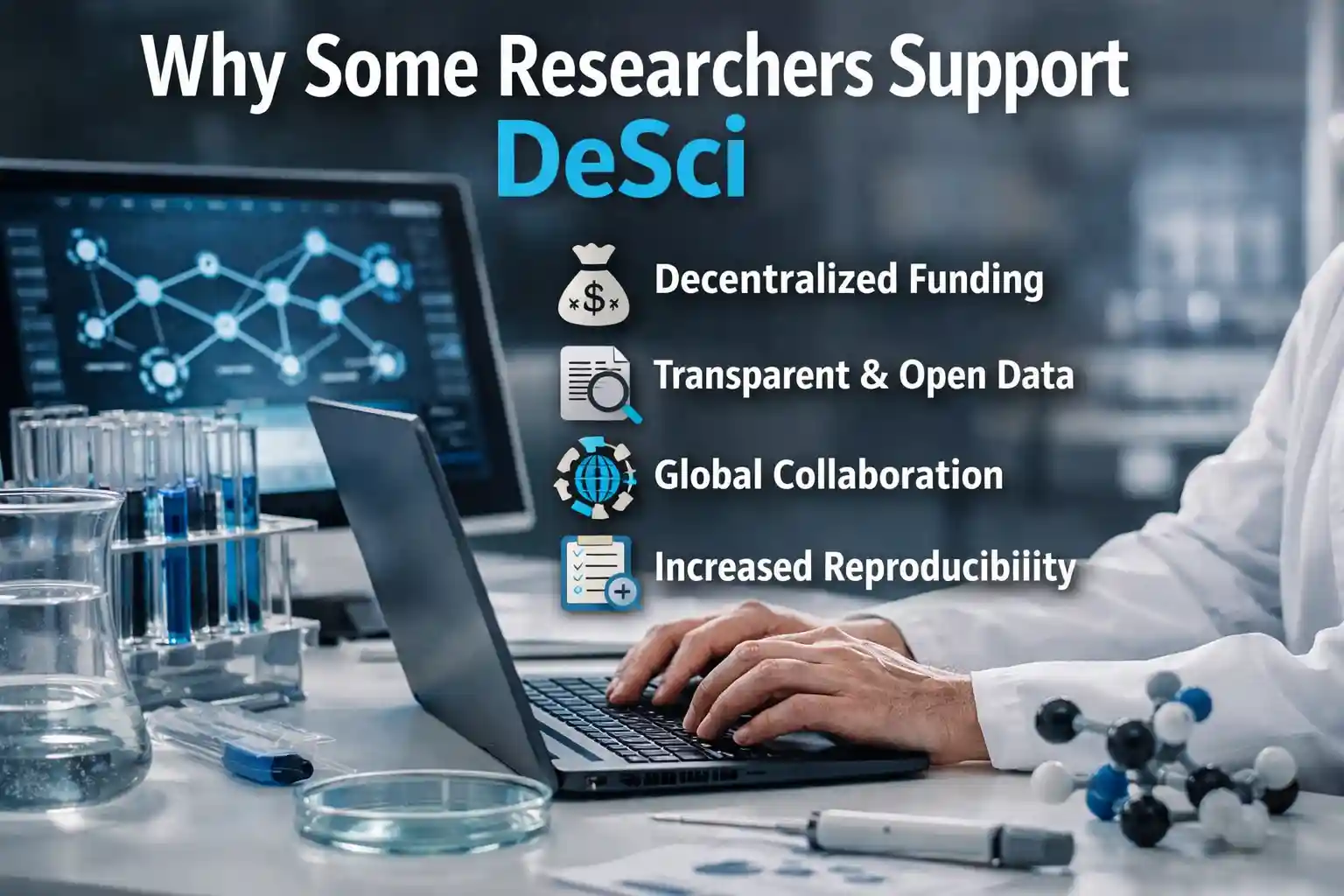
Addressing Funding Bottlenecks
One motivation behind DeSci involves the difficulty many scientists face when seeking grants.
Traditional funding agencies sometimes favor projects with predictable outcomes. High-risk ideas, particularly from early-career researchers, may struggle to gain support.
Community funding platforms could allow unconventional proposals to find backers outside institutional structures.
In theory, this system could widen the range of scientific exploration.
Improving Transparency in Research
Blockchain technology introduces a permanent ledger that records transactions and data entries. Every change leaves a timestamped trace.
Supporters argue that such records could strengthen research integrity. Data submissions, funding transactions, and peer review activities could all remain visible on the chain.
Transparency alone cannot eliminate scientific misconduct. Still, it might discourage some forms of manipulation.
Expanding Public Participation in Science
DeSci also invites participation from individuals outside academia.
Patients interested in rare disease research, citizen scientists, or independent scholars may contribute funding or expertise to projects they care about.
This wider participation reflects a broader cultural shift toward open collaboration on the internet.
Concerns and Criticism of DeSci
Governance and Expertise
One persistent concern centers on governance.
Scientific research depends on careful evaluation by experts. If voting power in decentralized networks depends primarily on token ownership, wealthy participants could gain disproportionate influence.
Finding ways to balance openness with expertise remains a major challenge.
Regulatory and Institutional Barriers
Universities operate within strict financial and legal frameworks. Cryptocurrency funding or blockchain-based governance systems may conflict with existing policies.
As a result, many academic institutions approach DeSci cautiously.
Technical Complexity
Blockchain tools still require technical knowledge. Managing wallets, tokens, and decentralized platforms can confuse researchers unfamiliar with cryptocurrency systems.
Until interfaces become easier to use, widespread adoption may remain limited.
Can Traditional Science and DeSci Work Together?
The conversation about TradSci versus DeSci sometimes sounds like a competition. In reality, the future may involve cooperation between both systems.
Some DeSci projects already collaborate with universities and research institutes. These partnerships allow decentralized platforms to access laboratory infrastructure and academic expertise.
Meanwhile, traditional institutions experiment with blockchain tools for data verification and grant management.
Hybrid models could emerge where decentralized funding supports early-stage ideas while established institutions provide oversight and facilities for large-scale research.
Such arrangements may combine flexibility with scientific rigor.
How the Scientific Landscape Might Change
Predicting the future of research systems remains difficult. Scientific institutions evolve slowly because they carry heavy responsibilities for accuracy and trust.
Still, several trends suggest that experimentation with decentralized tools will continue.
Digital collaboration networks have already reshaped many industries. Open source software communities demonstrated that distributed groups can build complex systems without centralized control.
Whether similar models can sustain rigorous scientific research remains an open question.
Yet the growing interest in DeSci indicates that many researchers believe the current system could benefit from new ideas.
Frequently Asked Questions About Traditional Science vs DeSci
What is the main difference between traditional science and DeSci?
Traditional science relies on centralized institutions such as universities, government agencies, and academic publishers. DeSci distributes funding, governance, and collaboration across blockchain-based networks where communities can participate directly.
Does DeSci replace peer review?
Not necessarily. Some decentralized platforms experiment with community-driven review systems. Others still involve academic experts. Most researchers expect peer evaluation to remain essential for maintaining research quality.
Can DeSci fund real scientific research?
Yes, though the scale remains modest. Several DeSci organizations and blockchain communities have funded research initiatives through decentralized grant programs and token-based funding pools.
Why do some scientists remain skeptical?
Concerns include governance fairness, regulatory uncertainty, and the challenge of maintaining scientific rigor within open digital networks.
Conclusion: Two Models Shaping the Future of Research
Traditional science built the foundation of modern knowledge. Its institutions developed methods for peer review, grant evaluation, and long-term research infrastructure. These systems remain essential for many forms of discovery.
At the same time, the rise of decentralized technology has introduced new questions. Who should fund research? Who controls access to knowledge? How transparent should scientific processes become?
DeSci represents one attempt to answer those questions. By combining blockchain systems, community funding, and open data networks, it proposes a different structure for scientific collaboration.
The outcome remains uncertain. Some projects may struggle with governance or technical barriers. Others could demonstrate useful alternatives for funding early-stage research.
For now, the relationship between traditional science and DeSci appears less like a rivalry and more like an ongoing experiment.
Author Recommendation
Readers exploring the debate between traditional science and decentralized science should approach the topic with curiosity but also a measure of caution. The existing research system carries centuries of experience. It built the laboratories, universities, and peer review structures that make modern discovery possible. Those institutions will not disappear soon, nor should they. Large-scale experiments, medical trials, and space missions depend on stable organizations and long-term funding.
Still, dismissing DeSci entirely may overlook useful ideas. Blockchain technology offers transparent record-keeping, new funding channels, and broader public participation in research. These features could complement the traditional model rather than replace it. Early experiments in decentralized funding suggest that communities sometimes support research areas that mainstream funding bodies overlook.
The most productive path likely lies somewhere in between. Universities and research agencies could explore blockchain tools for grant transparency or open data sharing. DeSci communities could collaborate with established scientists to maintain rigorous standards. When these two approaches interact thoughtfully, they may produce a research ecosystem that remains trustworthy while becoming more open and flexible.
Scientific progress has always involved adaptation. The discussion around DeSci reflects another moment in that long evolution.


