
Hippocrat (HPO): Incentivizing Healthcare Research with Crypto

If you have ever tried to switch doctors or get a second opinion, you know the nightmare: fax machines, lost records, and the realization that your medical history is trapped in a dozen different databases.
Even worse, that data, your blood work, your genetic scans, your history, is worth billions. Companies like 23andMe or large hospital networks monetize it regularly. You, the “data owner,” get $0.
Hippocrat (HPO) is a Decentralized Science (DeSci) protocol designed to flip this model. By moving from a simple token to a dedicated Layer 1 blockchain, Hippocrat aims to let patients own, secure, and finally monetize their most valuable asset: their health.
Note: This article covers Hippocrat (HPO), the blockchain project formerly known as Humanscape. We are not covering “Hippocratic AI,” the NVIDIA-backed generative AI company building nurse bots. They are separate entities.
The Core Problem: Data Silos and Free Patient Data
In the current Web2 healthcare model, you are not the customer; you are the product.
The Current Model (Web2 Healthcare)
Your medical data currently lives in “Data Silos.” Your dermatologist has one record; your general practitioner has another. These systems rarely talk to each other due to a lack of Data Liquidity Pools.
Worse, this fragmentation kills research. If a pharmaceutical company wants to study a rare disease, it has to negotiate with hundreds of individual hospitals to get enough data. This slowness costs lives. Meanwhile, data brokers sell anonymized aggregations of Electronic Health Records (EHR) for massive profit, while patients receive nothing but bills.
The Hippocrat Solution: Data Sovereignty
Hippocrat proposes a “Patient-First” data economy. Instead of your data living on a hospital server, it is encrypted and tied to your Decentralized Identifiers (DID).
- You control the key: You log in with your wallet, not an email.
- You grant access: If a researcher wants your data, they request it via Smart Consent contracts.
- You get paid: If you agree, you are compensated in crypto.
How Hippocrat Works: The Tech Under the Hood

To handle sensitive medical data at a global scale, Hippocrat is undergoing a major technical evolution.
From Humanscape (HUM) to Hippo Protocol (HP)
Long-time crypto investors might remember this project as Humanscape (HUM). The rebrand to Hippocrat (HPO) signaled a shift toward a global vision.
Now, in late 2024/2025, the project is migrating to the Hippo Protocol (HP), a standalone Layer 1 Blockchain built on the Cosmos SDK.
Why Cosmos? Building on Cosmos allows for IBC (Inter-Blockchain Communication). This means health data on the Hippo chain can eventually interact with insurance dApps on Ethereum or payment rails on Solana without complex bridges.
Zero-Knowledge Proofs (ZKPs) in Healthcare
Privacy is the biggest hurdle in medical crypto. How do you prove you have a specific condition for a clinical trial without revealing your identity?
The answer is Zero-Knowledge Proofs (ZKPs).
- Scenario: A researcher needs patients with Type 2 Diabetes.
- ZKP Solution: Your wallet generates a cryptographic proof that says “Yes, this user matches the criteria,” without revealing your name, address, or specific lab values.
Proof of Medical Contribution (PoMC)
Bitcoin uses “Proof of Work” (hardware mining). Hippocrat uses Proof of Medical Contribution (PoMC).
In this system, you don’t mine with a graphics card. You “mine” by uploading verified health data, such as genetic test results or daily symptom logs, to the network. The more high-quality data you contribute to the Bio-Data Monetization pool, the more rewards you earn.
PoMC Insight: As a writer who has covered health-tech for a decade, I recall trying to consolidate my own family’s records for a specialist visit. It took three weeks and $50 in “processing fees.” The ability to hold a verified, portable medical “passport” via a DID isn’t just about crypto speculation; it’s a desperate efficiency need for the actual healthcare consumer.
Ecosystem & Utility: Where is HPO Used?
This isn’t just a whitepaper; the ecosystem has active applications, particularly in South Korea.
Rarenote and Clinical Trial Matching
Rarenote is the flagship application. It specifically targets patients with rare diseases, a group often ignored by big pharma due to small sample sizes.
- Utility: Patients upload their genetic data to Rarenote.
- Outcome: The app matches them with global Clinical Trial Matching opportunities they wouldn’t have found otherwise.
DeSci: The Partnership with ResearchHub
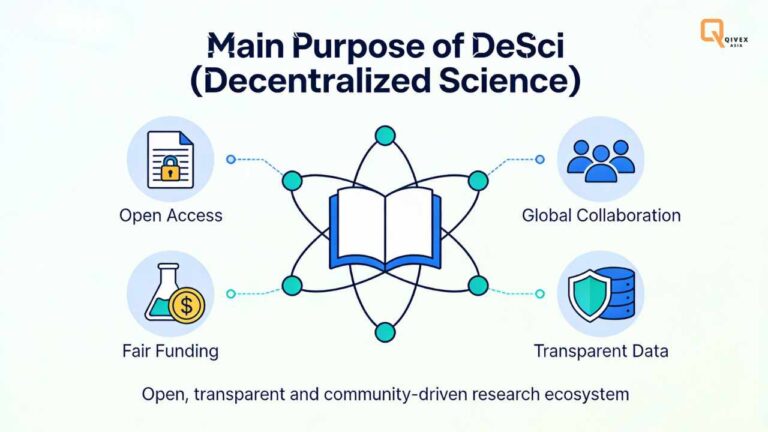
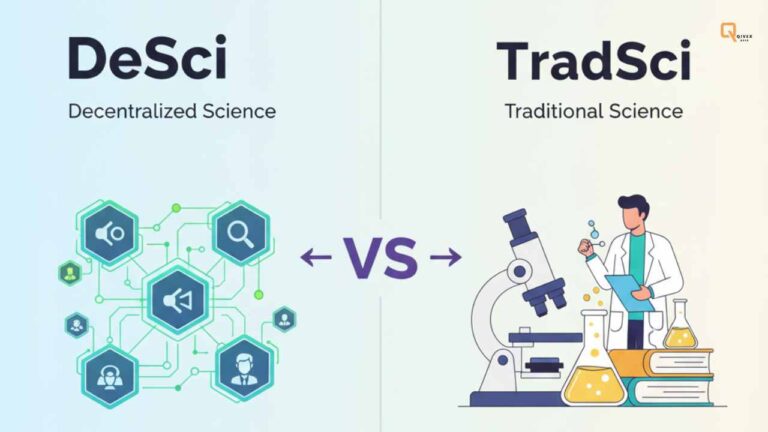
Hippocrat is a key player in the DeSci (Decentralized Science) movement. By partnering with platforms like ResearchHub, Hippocrat aims to fund open-source medical research directly. This bypasses the traditional “Publish or Perish” academic model, allowing scientists to crowdfund studies on neglected diseases using HPO Token grants.
Telemedicine in “Medical Deserts”
One of the roadmap goals is addressing Medical Deserts regions with no nearby doctors. The protocol incentivizes Telemedicine Incentives, allowing doctors to earn HPO for verifying data or providing remote consultations to verified users on the network.
Tokenomics and The HPO vs. HP Transition
If you are an investor or a user, the migration is the most critical immediate detail.
HPO Token Utility
Currently, the token serves two main roles:
- Payment: Researchers pay in HPO (or fiat converted to HPO) to access Anonymized Patient Data.
- Governance Staking: On the new mainnet, users will stake tokens to Validator Nodes to secure the network and vote on protocol upgrades.
The Migration Guide
As Hippocrat launches its mainnet, the ERC-20 (Ethereum) HPO tokens are swapping to the native Hippo Protocol (HP) coin.
- The Ratio: The swap is typically 1:1.
- The Method: Most users on major exchanges will see this happen automatically. Self-custody users will need to use the official bridge.
- Action Item: Always verify the Contract Address on the official Hippocrat website before interacting with any migration tool to avoid phishing scams.
Conclusion: The Future of Patient-Owned Health
Hippocrat represents a fundamental shift from “Patient as Product” to “Patient as Partner.”
By combining Off-Chain Storage for heavy data (like MRI scans) with on-chain permissions via Smart Contracts, it solves the privacy paradox that has held digital health back for decades.
My Analysis: This aligns with the 2024 trends we are seeing in the broader DeSci market. As AI requires more clean, structured data, the value of verified human health data is skyrocketing. Hippocrat is positioning itself as the marketplace for that data.