MedDAO: Peer-To-Peer Medical Research Funding

MedDAO and the Rise of Decentralized Medical Research
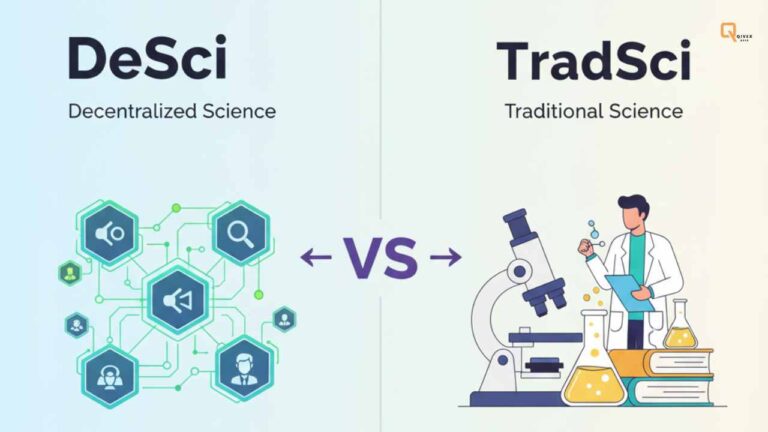
If you have ever tried to track where your donation to a medical charity actually goes, you know the frustration. The traditional system, or TradSci, is a black box. You donate, and years later, you might hear about a breakthrough. More often, the money evaporates into administrative fees, or the research hits a dead end because the data wasn’t shared.
I’ve spent the last few years auditing the “plumbing” of the scientific industry, specifically how Web3 Science is attempting to fix broken incentives. I recently participated in a Quadratic Funding round on Gitcoin, where I saw firsthand how a community of just 500 people could fund a specific longevity study that big pharma had ignored. It was faster and more transparent than any grant process I’ve witnessed in academia.
This brings us to MedDAO, a concept and a movement that promises to turn patients from passive subjects into active owners of medical research.
What is MedDAO? (Defining the Concept)
It is crucial to clarify a common confusion immediately: “MedDAO” refers to both a specific organization and a broader category of Decentralized Science (DeSci) projects.
The Core Mission: Connecting Patients, Doctors, and Researchers
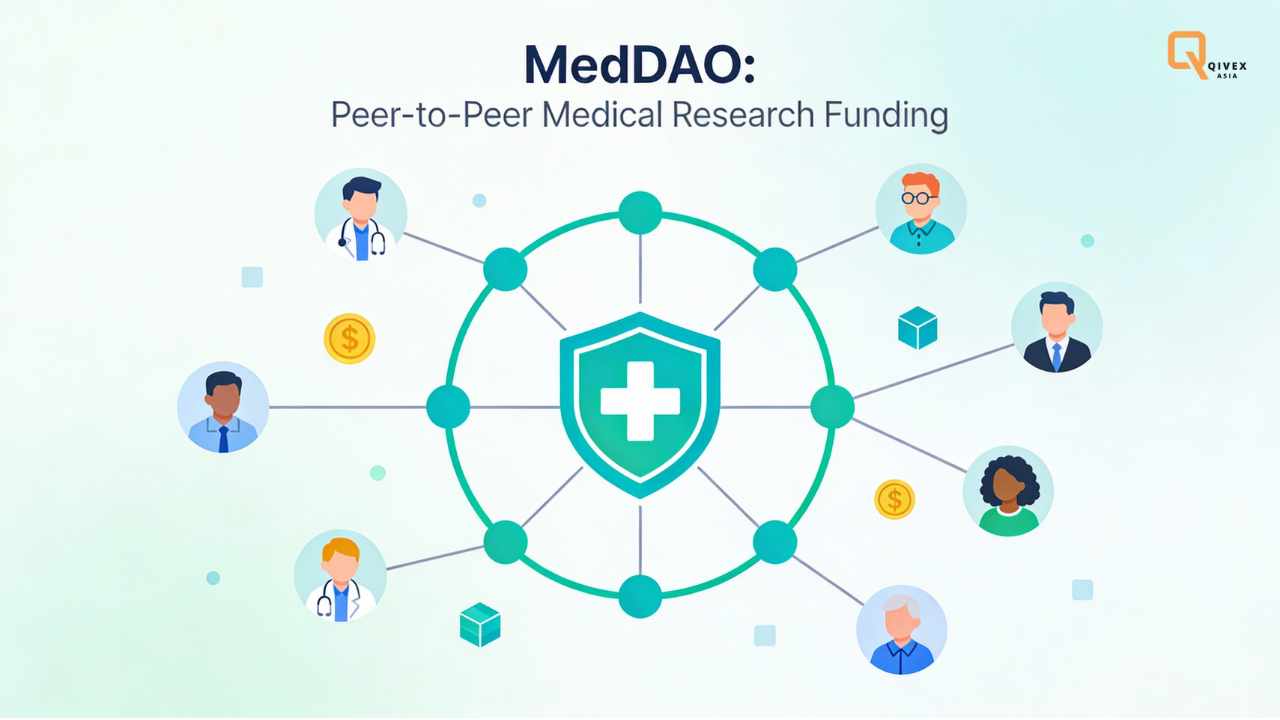
At its simplest, a Medical DAO (Decentralized Autonomous Organization) operates as a peer-to-peer cooperative. Instead of a centralized board of directors deciding which diseases to cure, a community of patients, doctors, and researchers holds Governance Tokens. They vote on proposals, allocate funds, and crucially share in the ownership of the results.
Beyond the Hype
This is not just “crypto charity.” In a traditional charity, you give money away. In a MedDAO, you are investing capital (or data) into a BioDAO. If that DAO funds a breakthrough drug, the value flows back to the community treasury, potentially funding more research. It creates a circular, self-sustaining economy for science.
The MedDAO Ecosystem
While there is a specific project named MedDAO (focused largely on telemedicine and medical knowledge networks in the metaverse), the term is often used to describe the entire vertical of medical DAOs. This guide focuses on the broader mechanism of Peer-to-Peer Medical Research Funding.
Why Healthcare Needs a DAO? The Problem
To understand the solution, we must look at why the current machine is stalling.
Data Silos & Privacy
Your medical data is currently fragmented across dozens of Electronic Health Records (EHR) systems that don’t talk to each other. This is known as Siloed Data.
The Reality: A researcher trying to cure a rare disease often spends more time begging hospitals for data access than actually analyzing the data. MedDAOs aim to build Data Unions where patients aggregate their own data and grant access directly to researchers.
The “Valley of Death”
There is a notorious funding gap in biotech called the “Valley of Death.”
Basic Research: Funded by government grants (slow, bureaucratic).
Clinical Trials: Funded by VCs/Pharma (profit-driven, risk-averse).
The Gap: Promising early-stage research that isn’t “profitable enough” for VCs often dies here. MedDAOs bridge this gap by funding high-risk, high-reward science that traditional finance ignores.
Misaligned Incentives
Pharmaceutical companies are legally bound to maximize shareholder value, not patient health. This leads to a focus on chronic treatments (lifetime customers) rather than cures. Patient Governance flips this. When patients control the DAO, the incentive becomes curing the disease.
How MedDAO Works: The Mechanism of Action

This isn’t magic; it’s a new technical stack.
Decentralized Governance
In a MedDAO, one token equals one vote (usually). If a researcher proposes a new study on autoimmune diseases, the community reviews it. This is Democratized Access to scientific decision-making.
IP-NFTs Explained
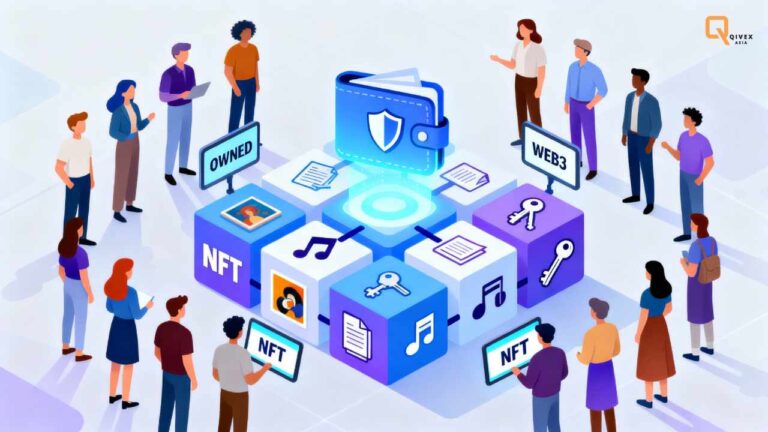
This is the “killer app” of DeSci. An IP-NFT (Intellectual Property Non-Fungible Token) turns a patent or a dataset into a liquid, tradeable digital asset.
- How it works: A researcher mints their project as an IP-NFT.
- Funding: The DAO buys the NFT (funding the research).
- Outcome: If the research yields a patent, the NFT represents the legal ownership of that IP. The DAO can then license it to a pharma company, and the revenue flows back to the DAO.
Verifying Expertise with Soulbound Tokens (SBTs)
We don’t want just anyone voting on complex medical protocols. Soulbound Tokens (SBTs) are non-transferable tokens that act as digital resumes. A verified doctor could receive a “Medical Expert” SBT, giving their vote more weight in technical decisions without requiring them to reveal their real-world identity publicly. This builds an On-chain Reputation.
Key Features of the MedDAO Model
Peer-to-Peer Funding
MedDAOs often use Quadratic Funding to match donations. This is a mathematical formula that prioritizes the number of unique contributors over the amount donated.
Example: A project with 100 donations of $10 might get more matching funds than a project with one donation of $1,000. This prevents “whales” from dictating the research agenda.
Data Monetization for Patients
Instead of 23andMe selling your genetic data and keeping the profit, MedDAOs allow for Data Sovereignty. You could upload your anonymized MRI scans to a marketplace. Researchers pay the DAO to access this Longitudinal Study data, and you receive a portion of the payment.
Global Collaboration
Rare diseases are, by definition, rare. Finding enough patients for a trial in one city is impossible. MedDAOs are borderless. They can aggregate Patient-Reported Outcomes (PROs) from patients in 50 different countries, creating a dataset large enough for meaningful analysis.
Real-World Use Cases & Competitors
The theory is solid, but who is actually doing it?
MedDAO vs. VitaDAO
MedDAO (The Project): Primarily focuses on connecting healthcare providers, creating a “knowledge layer” for medical professionals to collaborate globally.
VitaDAO: The gold standard for BioDAOs. They focus specifically on Longevity research. They have successfully funded projects at the University of Copenhagen and even spun out a biotech company.
The Role of Molecule
Molecule is the infrastructure layer; think of it as the “Shopify for Science.” They provide the legal and technical frameworks that allow DAOs like VitaDAO and AthenaDAO (focused on Women’s Health) to exist. They pioneered the IP-NFT framework.
Case Study: The “Patient Investor”
Imagine a patient with a rare skin condition.
- They join a Dermatology BioDAO.
- They purchase governance tokens or earn them by uploading their daily symptom logs (Incentivize Participation).
- The DAO finds a researcher with a promising new cream but no funding.
- The patient votes to fund the researcher.
- The research succeeds. The IP is licensed. The patient feels a sense of ownership and potentially sees the DAO treasury grow, funding the next cure.
Challenges and Risks
We must be realistic. This technology is experimental.
Regulatory Hurdles
Health data is strictly regulated (e.g., HIPAA Compliance in the US, GDPR in Europe). Moving this data on-chain requires complex privacy solutions like Zero-Knowledge Proofs. Furthermore, if a DAO token gives you a share of profits, the SEC might classify it as a security.
Quality Control
There is a risk of “mob rule.” Can a community of patients accurately judge the scientific merit of a complex proposal? This is why LabDAO (focused on execution) and expert committees within DAOs are essential to vet the science before the community votes.
How to Get Involved in MedDAO
If you want to move from observer to participant:
- Join the Discord: Almost all activity happens in Discord servers. Introduce yourself.
- Contribute Labor: You don’t need money. You can contribute by translating papers, managing communities, or writing code.
- Acquire Governance Tokens: If you choose to invest financially, understand the risks. You are buying voting rights, not a guaranteed return.
Frequently Asked Questions (FAQ)
Is MedDAO a non-profit?
Not necessarily. Most BioDAOs are set up as non-profit associations (often in Switzerland) that own for-profit subsidiaries. The goal is sustainability, not just charity.
Can I make money by contributing my medical data?
In the future, yes. Currently, most models incentivize data contribution with governance tokens (voting power) rather than direct cash, creating a model of Shared Ownership.
What happens if a MedDAO-funded drug succeeds?
The intellectual property (IP) is owned by the DAO. The DAO can license this IP to a pharmaceutical company for a fee. That fee goes back into the DAO treasury to fund more research.