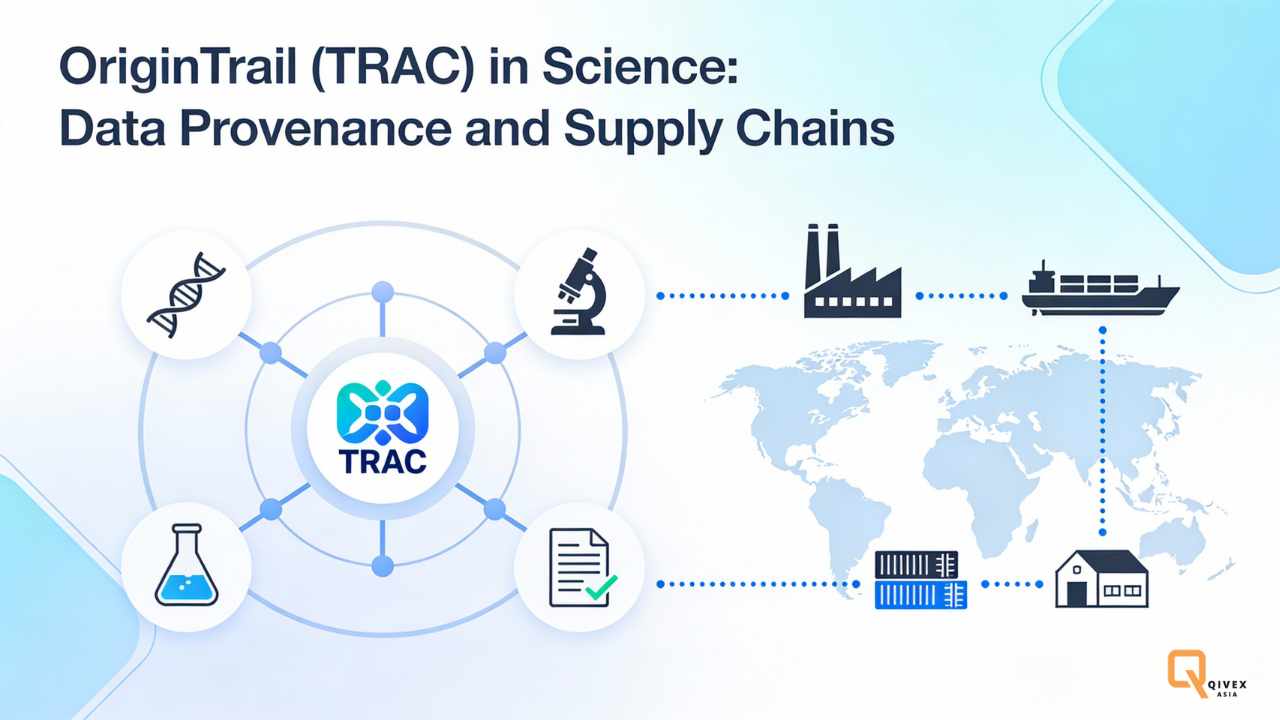
OriginTrail (TRAC) in Science: Data Provenance and Supply Chains

How OriginTrail (TRAC) is Securing the Future of Decentralized Science and Data Provenance
In the world of scientific research, trust is the currency of progress. Yet, as we race toward an AI-driven future, that currency is being debased. We face a Reproducibility Crisis where results cannot be verified, and a “Black Box” AI problem where we don’t know if a medical algorithm was trained on peer-reviewed data or Reddit threads.
I have spent years analyzing supply chain protocols, and the shift I am witnessing now is profound. We are moving from tracking physical goods (like shipping containers) to tracking verifiable truth. OriginTrail (TRAC) is not just a crypto token; it is the middleware of this new Decentralized Science (DeSci) economy.
This guide explores how OriginTrail’s Decentralized Knowledge Graph (DKG) is solving the data provenance crisis, moving from pharmaceutical supply chains to the frontier of “Agentic Science.”
The Core Problem: The Trust Crisis in Science and Supply Chains

The current infrastructure of TradSci (Traditional Science) is built on silos. Data is locked in proprietary databases, PDFs, and disconnected servers. This fragmentation creates three massive risks.
The Data Black Box
When an AI model suggests a new drug candidate, can you audit its thought process? Often, the answer is no. We cannot verify the origin (provenance) of the training data. Without a transparent Data Availability Layer, we risk building our scientific future on shaky, unverified foundations.
The Reproducibility Crisis
A significant percentage of scientific studies cannot be reproduced. This isn’t always malice; often, it’s because the raw data is inaccessible. In the current system, Scientific Data Integrity relies on reputation, not cryptographic verification. This leads to retracted papers and wasted billions in funding.
Why Blockchains Alone Aren’t Enough
A common misconception is that “putting it on the blockchain” solves this. It doesn’t. Blockchains are slow ledgers for transactions, not databases for complex relationships.
Expert Insight: In my analysis of early supply chain pilots, I observed that pure blockchain solutions failed because they couldn’t query data efficiently. You need a Graph Database to map relationships (e.g., “Researcher A” published “Dataset B” derived from “Trial C”). This is where the Decentralized Knowledge Graph (DKG) bridges the gap, organizing complex data while using the blockchain only for the “proofs.”
Phase 1: Proven Success in Pharmaceutical Supply Chains
Before OriginTrail entered science, it proved itself in the high-stakes world of global logistics. This is not vaporware; it is running in production.
The BSI Partnership & “AidTrust”
One of the most powerful applications of the DKG is AidTrust, developed in partnership with the British Standards Institution (BSI). This tool tracks donated medicines flowing into regions like India and Africa.
The Problem: Up to 30% of donated medicines were historically lost to theft or diversion.
The Solution: By creating Audit Trails on the DKG, BSI could ensure Cold Chain Custody and delivery. The system flags anomalies in real-time, ensuring medicines reach the patients, not the black market.
Stopping Counterfeit Drugs
Using GS1 Standards and EPCIS (Electronic Product Code Information Services), OriginTrail allows for granular tracking. Every box of medicine has a digital twin. If a counterfeit box appears in the supply chain, the system detects the duplicate serial number immediately.
Case Study: The World Federation of Hemophilia
The World Federation of Hemophilia utilizes this tech to track the distribution of specialized treatments. In rare disease communities, every vial counts. The DKG ensures that donors can verify their aid reached the intended recipient, solving the “last mile” problem of trust.
Phase 2: The Pivot to DeSci (Decentralized Science)
OriginTrail has effectively pivoted from tracking boxes to tracking knowledge. This is the “Blue Ocean” for the protocol.
What is the DeSci Paranet?
A Paranet is a user-owned, autonomous knowledge graph that lives within the wider DKG. Partnering with ID Theory, OriginTrail launched the DeSci Paranet. Think of it as a dedicated library for scientific data. Unlike a centralized library, this one is owned by the researchers who contribute to it. It allows for Knowledge Mining, where contributors are rewarded for adding verified, high-quality data to the graph.
Tokenizing Knowledge: IP-NFTs
Researchers can now wrap their datasets or patents into Intellectual Property Non-Fungible Tokens (IP-NFTs).
Old Model: You publish a paper, the publisher puts it behind a paywall, and you earn nothing.
DeSci Model: You publish a dataset as a Knowledge Asset on the DKG. You retain Patient Data Sovereignty and ownership. If a pharma company wants to use your data for AI training, the Smart Contracts automatically route royalties to you.
Solving the “Valley of Death”
Promising biotech research often dies because early-stage startups can’t prove their data is robust enough for investors. By using Research Provenance on the DKG, startups can offer a cryptographic “proof of progress,” making it easier to attract funding from a BioDAO or venture capital.
Phase 3: Agentic Science & The Future of AI Research
The most exciting development is the convergence of AI Agents and the DKG.
The Oxford PharmaGenesis Collaboration
OriginTrail is collaborating with Oxford PharmaGenesis, a leader in Medical Comms, to build an AI-ready ecosystem. The goal is to make medical literature “readable” by AI agents. Instead of an AI scraping a PDF and misinterpreting a p-value, it queries the structured Knowledge Assets directly.
Neuro-symbolic AI Explained
We are entering the era of Neuro-symbolic AI.
Neural AI (LLMs like GPT-4): Great at creativity and language, but prone to “hallucinations” (making things up).
Symbolic AI (The DKG): A rigid network of facts and relationships. By combining them, we get Hallucination-free AI. The LLM uses the DKG as a factual grounding layer. It effectively “looks up” the citation before writing the sentence, ensuring Scientific Data Integrity.
AI Agents as Researchers
We are building a Verifiable Internet for AI. Soon, autonomous AI agents will scour the DKG to find obscure correlations between diseases and proteins—connections that humans missed and propose new Clinical Trial Verification protocols instantly.
Technical Deep Dive: How the DKG Verifies Science
Uniform Asset Locators (UALs)
In Web2, we use URLs to find a website. In the DKG, we use Uniform Asset Locators (UALs). A UAL points to a specific piece of knowledge (e.g., a specific gene sequence or a line of code) and its entire history on the blockchain. This makes every data point citeable and verifiable.
Knowledge Mining
This is the incentive layer. Scientists and institutions can run nodes to perform Knowledge Mining. They process and structure data for the graph, and in return, they earn TRAC tokens. This transforms scientific data from a static cost center into an active asset class.
The Future Roadmap: TRAC’s Role in Global Knowledge
The Shift from “Track and Trace” to “Verify and Discover”
OriginTrail is evolving into the search engine for the Semantic Web3. It is moving beyond simple logistics to becoming the “Source of Truth” for the AI era.
Summary: The “Google” of the DeSci Movement
If Google indexes the web of pages, OriginTrail indexes the web of verified assets. For DeSci to succeed, it needs a layer that organizes truth without a central gatekeeper. That is the role TRAC plays.
Frequently Asked Questions (FAQ)
How is OriginTrail used in healthcare?
It is used to ensure Patient Data Sovereignty, track pharmaceutical supply chains (via AidTrust), and verify clinical trial data to prevent fraud.
What is the difference between Trace Labs and OriginTrail?
Trace Labs is the core development company building the software. OriginTrail is a decentralized protocol and network that anyone can use.
How does the DKG prevent fake scientific news?
It uses Vector Embeddings and cryptographic proofs. If an AI references a study, the DKG can verify if that study actually exists, who published it, and if the data has been altered, effectively preventing Hallucination-free AI errors.