



Reader Disclosure
This content is created for educational and informational purposes only. It does not constitute financial, legal, or professional medical advice. While we strive for accuracy in the rapidly evolving fields of DeSci and AI, readers should conduct their own research before making decisions based on this information.
Enterprise blockchain, the idea of a shared, immutable, and highly secure ledger driving global business, has moved beyond the initial hype cycle. While the potential for Distributed Ledger Technology (DLT) to revolutionize everything from Supply Chain Visibility to financial settlements remains undeniable, many organizations find themselves stuck in what Gartner calls the “trough of disillusionment.”
The truth is, while the technology itself is robust, successful enterprise adoption rarely fails because of the code. Instead, the real hurdles emerge during the transition from a Proof of Concept (PoC) Fatigue) to a full-scale production environment. Implementation stalls due to fundamental issues around integration, governance, and the very legal paradoxes that come with decentralization.
In this deep dive, we move past the sales pitch and offer a practical reality check on the primary challenges facing CTOs and business leaders today.
The Trilemma of Technical Limitations
The core problem for enterprise blockchain often boils down to a technical “trilemma”: balancing security, decentralization, and scalability. In the real world of high-volume business, one often has to be sacrificed.
Scalability and Throughput (TPS)
The primary headache for any DLT in a corporate environment is speed. While a private blockchain might be faster than its public counterpart, it still struggles to compete with centralized systems.
Consensus Latency: Blockchains rely on a Consensus Mechanism—a mandatory agreement among all participants (nodes) before a transaction is validated. This Consensus Latency inherently slows things down.
Throughput (TPS): Corporate networks often require thousands of transactions per second (TPS). Compared to a system like Visa, which handles thousands of transactions per second, many first-generation enterprise ledgers simply can’t keep up with high-frequency demands like Tokenization Assets or real-time inventory tracking.
Solution Angle: The industry is aggressively adopting solutions to increase speed. This includes specialized protocols like Sharding (breaking the ledger into smaller, manageable partitions) and utilizing Layer 2 Solutions that process transactions off-chain before settling them in batches on the main chain.
Interoperability: The Digital Island Problem
Imagine a global supply chain where one partner uses Hyperledger Fabric and another uses Corda. Currently, these chains operate as “Digital Islands,” and they cannot easily exchange data or value directly.
The challenge of connecting disparate DLT networks is critical for realizing the full value of a shared system. If the data is siloed on separate blockchains, the benefits of a shared, immutable truth vanish.
-
Solution Angle: This is being solved through Interoperability Protocols (like CCIP or IBC) and a technique called Atomic Swaps, which allow for trustless exchange of assets between different blockchains without an intermediary.
Integration with Legacy Systems (The ERP Nightmare)
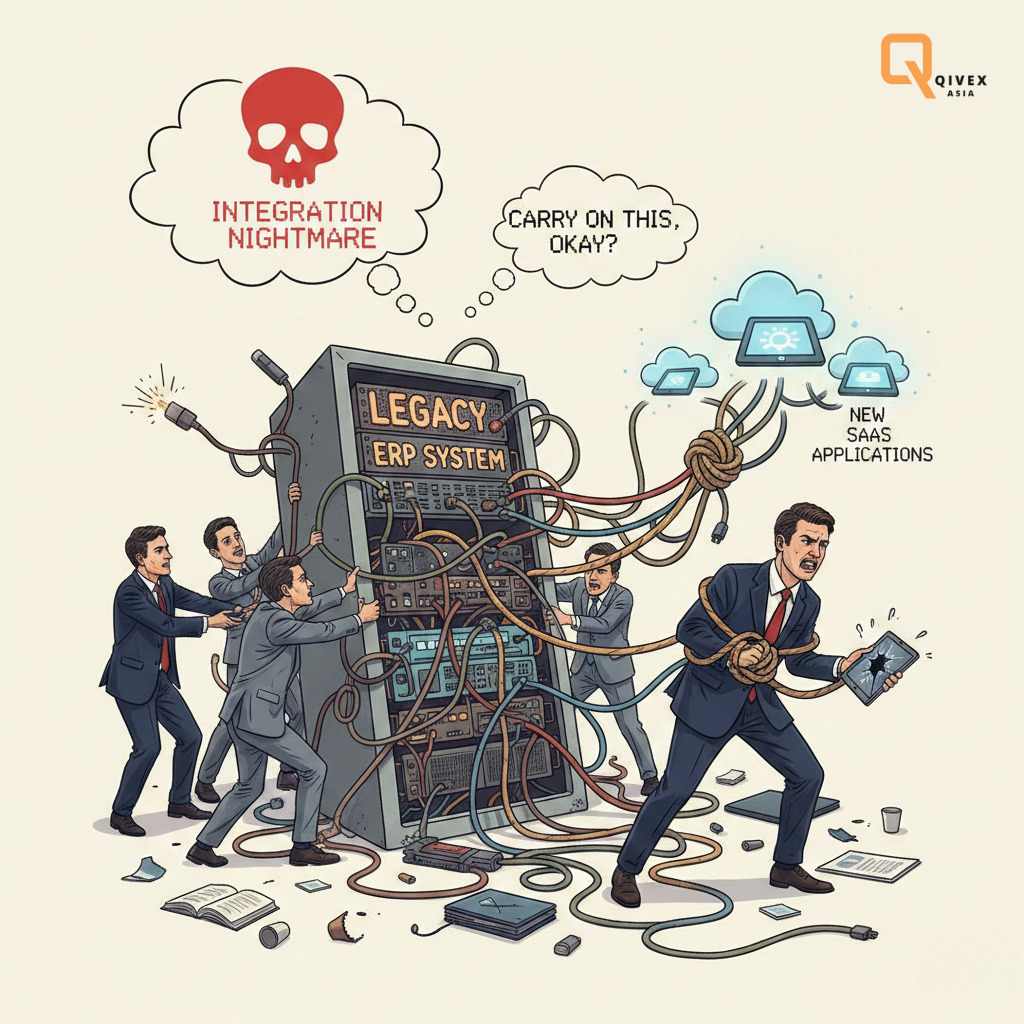
This is, arguably, the single greatest cause of PoC Fatigue. A blockchain is a modern, cryptographic database. Most enterprises run on Legacy ERP Integration systems, often 10 to 20 years old (like SAP or Oracle), built on completely different data models.
Challenge: Connecting a clean, cryptographically secured Immutable Ledger to an old database with messy, unstructured data requires complex middleware, Node Synchronization processes, and extensive data normalization.
My Experience/Expertise: During a large-scale Supply Chain Visibility project, we spent 70% of the budget not on the blockchain itself, but on building and maintaining the Application Programming Interfaces (APIs) and data normalizers to bridge the gap between the new DLT and five disparate legacy ERP systems. This deep integration is often the highest hidden cost.
Regulatory and Compliance Hurdles
The very nature of DLT decentralization and immutability collides head-on with established legal and compliance frameworks.
The Privacy Paradox: GDPR vs. Immutability
This is a profound legal challenge: How do you enforce a user’s “Right to be Forgotten” (a core part of GDPR Compliance) on an Immutable Ledger?
If a transaction record is permanently written to a chain, it cannot be erased.
Solution Angle: The enterprise solution is often a hybrid approach. Private vs. Permissioned ledgers keep personally identifiable information (PII) Off-chain (in a traditional, mutable database) and only store the cryptographic hash of the data on the blockchain. Advanced techniques like Zero-Knowledge Proofs (ZKPs) allow participants to cryptographically prove that a piece of information is true without ever revealing the information itself.
Jurisdictional and Legal Uncertainty
Data Sovereignty: If your Distributed Ledger Technology (DLT) network has Node Synchronization points in the EU, the US, and Asia, which legal jurisdiction governs the data? The issue of Data Sovereignty, where the data resides and whose laws apply, creates massive Regulatory Uncertainty.
Smart Contract Enforceability: Are code-based agreements legally binding in a traditional court? The enforceability of Smart Contract Enforceability remains a complex, unproven area in most legal systems, creating a barrier for high-value transactions.
Organizational and Governance Barriers
Beyond the code and the law, people and politics are often the final obstacle.
The Consortium Governance Crisis
Enterprise DLT is almost always deployed as a consortium, a network shared by multiple competitors (e.g., banks, shipping companies, or retailers). The technology requires shared investment and maintenance, which leads to conflict.
Key Question: “Who pays for the upgrade?” or “Whose features get prioritized?”
Establishing a clear and fair Consortium Governance model, including clearly defined voting rights and funding mechanisms, is politically challenging. Without it, Vendor Lock-in and network stagnation become inevitable.
The Skills Gap and Talent Shortage
The scarcity of specialized talent is acute. It’s not enough to hire a JavaScript developer; you need someone proficient in cryptographic security, enterprise architecture, and niche languages like Solidity or Rust, all while adhering to enterprise Identity Management (IAM) and security standards.
Hidden Costs and ROI Obscurity
The ROI Calculation for DLT is often opaque because the initial costs are significantly underestimated.
| Cost Component | Description |
| Cloud Infrastructure | High costs for maintaining global Node Synchronization and storage. |
| Smart Contract Audits | Mandatory, costly audits by third-party experts to check code for vulnerabilities. |
| ESG Concerns | Addressing energy consumption (even in Proof-of-Stake/Authority systems) to meet ESG (Environmental, Social, and Governance) mandates. |
Security Vulnerabilities in a Decentralized World
It’s a common misconception that blockchain is unhackable. While the ledger itself is cryptographically secure, the periphery is not.
Endpoint Vulnerabilities and Key Management
As the saying goes, “The blockchain isn’t hacked; the wallet is.” The most frequent point of failure is human error or poor endpoint security.
The security of your assets (or data) rests entirely on the integrity of your private keys. Robust Key Management Systems (KMS) are critical, as the loss or theft of a private key means the permanent and irreversible loss of access to your data or tokens.
Smart Contract Bugs and Exploits
Code is law on the blockchain, and immutable code containing a logic error is a ticking time bomb.
-
Example: The famous DAO hack was not an attack on the underlying Ethereum network but a successful exploitation of a flaw in the Smart Contract code. These errors lead to permanent loss. This is why meticulous Smart Contract Audits are non-negotiable before deployment.
Future-Proofing: Overcoming the Barriers
The industry is rapidly maturing to address these challenges, shifting focus from raw technology to streamlined applications.
My Conclusion Aligns with the 2024 State of the Industry Report by McKinsey, which notes that the future lies not in building proprietary, custom chains but in leveraging standardized platforms.
Moving toward BaaS: The rise of BaaS (Blockchain-as-a-Service) solutions from major cloud providers (AWS, Azure) significantly lowers the cost and technical debt associated with managing the underlying infrastructure, allowing enterprises to focus on the business logic.
The Rise of Hybrid Blockchains: The most practical enterprise solution is the hybrid model—using a private/permissioned layer for speed, low cost, and data privacy, while occasionally anchoring cryptographic proofs onto a public chain for superior transparency and security against 51% Attack Vectors.
A Strategic Checklist for CTOs
Before starting a new enterprise blockchain project, shift your focus from technology to governance. Answer these questions first:
-
Consortium Buy-in: Do we have a signed, legally binding Consortium Governance agreement before the first line of code is written?
-
Legacy Integration: Have we budgeted more time and money for Legacy ERP Integration than for the DLT platform development?
-
Legal Review: Has legal counsel confirmed the enforceability of the Smart Contract Enforceability clauses within all relevant jurisdictions?
By addressing the organizational, legal, and integration paradoxes first, you can navigate the challenges of enterprise blockchain and finally move from concept to scalable, high-value production.
Would you like me to find a BaaS provider that specializes in Supply Chain Visibility to help you begin your strategic planning?