



Reader Disclosure
This content is created for educational and informational purposes only. It does not constitute financial, legal, or professional medical advice. While we strive for accuracy in the rapidly evolving fields of DeSci and AI, readers should conduct their own research before making decisions based on this information.
The “Gold Rush” of 2023 is over. The days of viral Twitter threads claiming you can “make $10,000 a month just by using ChatGPT” are largely behind us. But as the hype fades, a much more substantial reality has emerged: the Infrastructure Phase.
Companies no longer need to be convinced that AI is real. They need to know how to use it without breaking their business. They don’t need hype; they need implementation.
This shift has created a massive opening for the Freelance AI Consultant. But first, we must make a crucial distinction. An “AI Freelancer” executes tasks (e.g., “I will generate 50 images for you”). An “AI Consultant” diagnoses problems and builds systems (e.g., “I will automate your customer onboarding flow”).
If you want a sustainable, high-income career in 2026, you must stop selling tasks and start selling solutions. Here is your strategic roadmap.
Defining Your Consultant Archetype (Don’t Be a Generalist)
The biggest mistake I see new entrants make is trying to be the “AI Guy for Everyone.” In consulting, a generalist is a commodity; a specialist is a surgeon. To command high fees, you need to pick a lane.
The Technical Architect
This path is for those with a background in development or data science. You aren’t just prompting; you are building the plumbing.
Focus: Building RAG (Retrieval-Augmented Generation) pipelines, managing Vector Databases (Pinecone), and handling Fine-Tuning Models on proprietary data.
Value Proposition: “I build secure, private intelligence layers for your company data.”
The Workflow Automator
This is the “Low-Code” route, ideal for operations managers or productivity geeks. You connect the brain (AI) to the hands (Software).
Focus: Using tools like Make.com (Integromat) or Zapier to connect OpenAI APIs to CRMs like Salesforce or HubSpot.
Value Proposition: “I save your sales team 10 hours a week by automating data entry.”
The Corporate Trainer & Strategist
Best for those with HR, Management, or Legal backgrounds. Companies are terrified of Data Privacy leaks and liability.
Focus: Employee Training Workshops, creating AI Governance & Ethics policies, and teaching teams how to prompt safely.
Value Proposition: “I ensure your team uses AI effectively without leaking trade secrets.”
Strategical Insight: When I first started consulting, I made the mistake of selling “AI Workshops” to anyone who would listen. It was a race to the bottom on price. When I pivoted specifically to “Workflow Automation for Real Estate Agencies,” my conversion rate tripled, and my retainer agreements went from $2,000 to $8,000 a month. Specialization builds trust.
What Actually Sells in 2026? The Service Menu
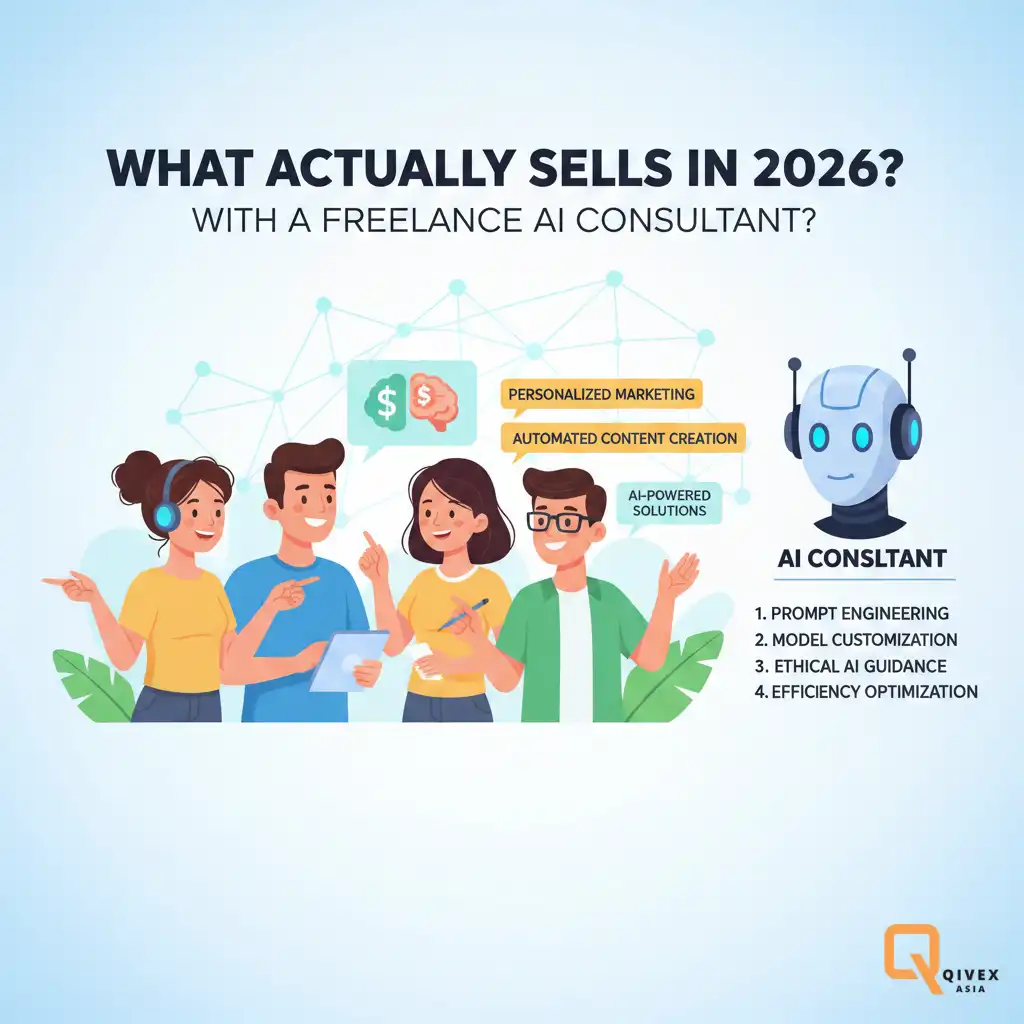
You cannot just sell “Consulting.” You need productized services. Think of your offering in tiers.
The AI Readiness Audit (The Foot-in-the-Door)
This is a low-risk, paid assessment. Instead of promising the moon, you sell a diagnostic.
The Deliverable: A roadmap analyzing the client’s current data infrastructure, potential ROI Calculation, and identified bottlenecks.
Why it works: It builds trust before a big contract. It moves you from a salesperson to a trusted advisor.
Custom Knowledge Base Bots (Internal RAG)
Every company wants a “ChatGPT that knows our business.”
The Service: Custom GPT Development. You ingest their SOPs, PDF manuals, and past emails into a secure vector database so HR or Support staff can “chat” with their documents.
The Benefit: Instant access to institutional knowledge.
Automated Content & Outreach Engines
This isn’t about spam; it’s about Human-in-the-Loop systems. You set up the Tech Stack Optimization where the AI drafts personalized emails or social posts based on news events, and a human approves them. It scales output without sacrificing quality.
Structuring Your Business for High Margins
How you charge determines how you are treated.
Pricing Strategy: Hourly vs. Value-Based
Never charge by the hour. AI makes you fast. If you charge by the hour, you are penalized for being efficient.
Hourly: “I charge $150/hour.” (Client watches the clock).
Value-Based Pricing: “This automation will save you $50,000 a year in administrative labor. My fee to build it is $10,000.” (Client sees a 5x ROI).
The “Discovery Call” Script
The goal of the Discovery Call is not to pitch; it is to diagnose.
Bad Question: “Do you want to use ChatGPT?”
Good Question: “Where is your team currently wasting the most time on repetitive data tasks?”
Key Insight: Sell the problem solved, not the AI tool used. Clients don’t care about LangChain; they care about reducing support tickets.
Building Your Tech Stack (Without Overwhelming Yourself)
You don’t need to know Python to be a six-figure consultant (though it helps). You need a reliable stack.
Essential No-Code/Low-Code Tools
Logic Layer: Make.com is generally preferred over Zapier for complex, branching logic.
Database Layer: Airtable or Google Sheets for structured data.
Intelligence Layer: OpenAI API or Anthropic (Claude) for the reasoning.
Security and Data Privacy (The Dealbreaker)
If you cannot answer the security question, you will lose the Enterprise Security contract.
The Fear: “Will our data be used to train ChatGPT?”
The Answer: You must understand API Privacy Policies (Enterprise/API usage usually is not used for training) and GDPR/Data Privacy regulations. Offering to set up Azure OpenAI instances (which offer higher security) is a massive selling point.
Research Support: This focus on security is critical. My approach aligns with the 2024 State of AI in the Enterprise report, which highlighted that “Data Privacy and IP Risk” remains the #1 barrier to adoption for 60% of executives.
Client Acquisition: Finding Businesses That Pay
Vertical Specialization
Why is “AI for Real Estate Agents” easier to sell than “AI for Small Business”? Real Estate Agents have the exact same problems (lead qualification, follow-up emails). You can build one solution and sell it 100 times (White-Labeling).
Leveraging LinkedIn and Case Studies
Move your profile from “I do AI” to “I helped Qivex reduce data analysis problems with ChatGPT.”
Publish Case Studies showing the “Before and After.”
Share snippets of your Workflow Automation diagrams (blurring sensitive data). Visuals of complex automations prove competence instantly.
A Strategic Checklist for Aspiring Consultants
Before you pitch your first client, audit your readiness:
The Skill Audit: Are you a Builder (Technical Architect) or a Solver (Workflow Automator)? Pick one.
The Portfolio: Do you have one “toy project” (e.g., a chatbot that answers questions about a specific book) that proves you can build RAG systems?
The Offer: Move away from “I do AI” to “I implement social media post automation using AI.”
The Contract: Do you have a Retainer Agreement template ready to prevent Scope Creep?
Conclusion: The Window of Opportunity
The market is shifting from “Curiosity” to “Utility.” The businesses that survive the next decade will be the ones that integrate AI into their operational DNA. They cannot do this alone.
Your opportunity lies not in being the smartest coder in the room, but in being the bridge between the raw power of No-Code Solutions and the specific business needs of your clients.
Final Advice: Start by solving one expensive problem for one specific niche. Don’t build a spaceship when they just need a bicycle.
The tools are ready. The market is waiting. Are you ready to build?