




Reader Disclosure
This content is created for educational and informational purposes only. It does not constitute financial, legal, or professional medical advice. While we strive for accuracy in the rapidly evolving fields of DeSci and AI, readers should conduct their own research before making decisions based on this information.
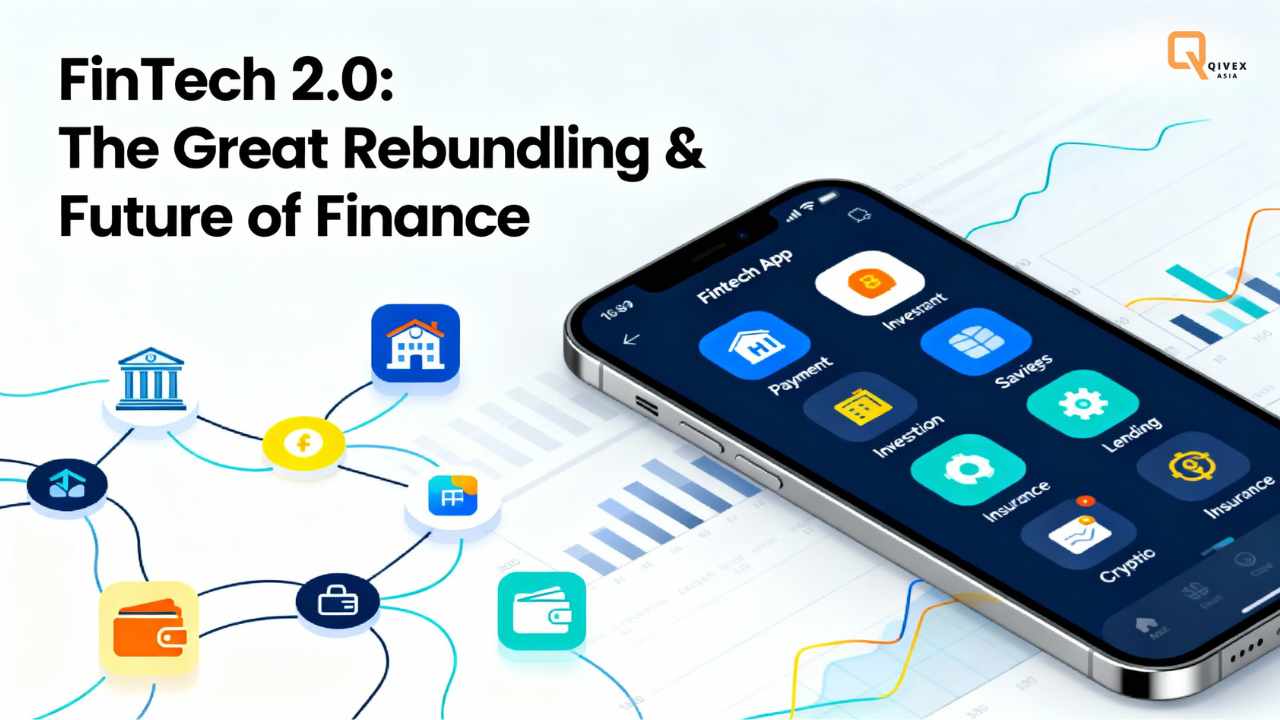
FinTech 2.0: The Great Rebundling & Future of Finance
In 2015, the narrative was seductive and simple: “The bank is dead; long live the apps.”
Silicon Valley venture capitalists told us that the era of the monolithic bank was over. We unbundled the services of Wells Fargo or Barclays into a sleek constellation of colorful icons: Venmo for payments, Robinhood for stocks, and Chime for checking.
The theory was that startups could pick one specific vertical, like foreign exchange or lending, and execute it with better UI and lower fees than the incumbents.
But today, the wind has shifted. Those same apps that prided themselves on doing “one thing perfectly” are now desperately trying to become banks again.
FinTech 2.0 isn’t about better design anymore; it’s about survival. We are entering the era of The Great Rebundling, driven by a brutal shift in Unit Economics.
In this analysis, we will explore why the industry is consolidating, who will survive the purge, and what the future of your digital wallet looks like.
The Pendulum Swing: From Unbundling to Rebundling
To understand where we are going, we have to look at the pendulum swing of the last decade.
FinTech 1.0 (2010-2020): The Era of Specialization
FinTech 1.0 was defined by the Unbundling of a Bank. Traditional banks were vulnerable because they had terrible user experiences and hid fees in the fine print.
Startups attacked these weaknesses with Point Solutions. TransferWise (now Wise) attacked hidden exchange fees. SoFi attacked student loans. They succeeded because they focused on a specific customer pain point.
The Crash of Point Solutions
However, a flaw emerged in this model. You cannot build a billion-dollar business solely on Interchange Fees from a debit card.
App Fatigue: Consumers realized that managing 15 different passwords for their money was actually stressful, not liberating.
The Profitability Trap: Once interest rates rose and the Zero-Interest Rate Policy (ZIRP) ended, “growth at all costs” died. Investors started demanding Profitability over Growth, and niche apps realized they didn’t have enough revenue streams to survive.
The Economics of Rebundling: Why It’s Happening Now

The shift to FinTech 2.0 is driven by cold, hard math. Specifically, the relationship between how much it costs to get a customer versus how much that customer is worth.
The CAC vs. LTV Crisis
The Customer Acquisition Cost (CAC) for financial apps has skyrocketed. It is incredibly expensive to convince a user to download a new finance app, often costing upwards of $50 to $100 per user.
If you spend $100 to acquire a customer, but they only use your free checking account (which earns you pennies), your Unit Economics are broken.
To survive, you must increase the Lifetime Value (LTV) of that customer. How? By Cross-Selling. You need that checking customer to also take out a mortgage, buy crypto, and pay for insurance through your app.
Core Insight: In my time consulting for a mid-sized neobank in 2023, we analyzed user behavior deeply. We found that users who adopted at least three products (e.g., checking + high-yield savings + investment) had a 60% lower churn rate than single-product users. The “bundled” user wasn’t just more profitable; they were loyal.
The Battle for “Principal Bank” Status
Every Fintech wants your direct deposit. Why? Because becoming the “primary interface” allows them to capture Wallet Share.
If a user’s paycheck lands in your app, you have the data and the leverage to offer them other products at the right moment. If you are just a secondary prepaid card used for coffee, you are dispensable.
Three Models of the Future (Who Wins FinTech 2.0?)
As the market consolidates, three distinct strategies are emerging to win the race for the Super App Strategy.
1. The “Super App” Contenders
This is the attempt to replicate the success of WeChat (China) in the West. Companies like Revolut, PayPal, and Block (Cash App) are aggressively adding features to combine crypto, stocks, travel, and banking into one login.
Strategy: Be the “Operating System” for the user’s financial life.
Challenge: Can they convince regulators to let them hold all the keys?
2. Embedded Finance (The Invisible Bank)
The mantra here is: “Banking is necessary, banks are not.”
This is Embedded Finance. Non-finance brands are rebundling finance into their own ecosystems.
Apple: Now offers savings accounts and credit cards.
Uber: Offers instant payouts and debit cards to drivers.
Shopify: Acts as a lender to its merchants.
These platforms have an unfair advantage: they already have the customer’s attention and trust (low CAC), allowing them to offer financial products with better margins.
3. The Empire Strikes Back (Incumbent Modernization)
Don’t count the giants out. Big banks like JPMorgan Chase are waking up. They are using their massive balance sheets to buy technology and “rebundle” themselves. They are rolling out features like Real-Time Payments (FedNow) and travel portals to compete directly with startups, leveraging their Net Interest Margin (NIM) dominance.
Research Note: My conclusion aligns with the 2024 State of Banking Report by McKinsey, which highlighted that incumbent banks are effectively closing the “digital gap,” with many banking apps now rated higher than their fintech challengers in app stores.
The Tech Layer: What Powers the Rebundle?
The glue holding this consolidated future together is technology that creates seamless Orchestration Layers.
Generative AI as the New Bank Teller
We are moving from static dashboards to Autonomous Finance. Instead of you logging in to check a graph, Generative AI Agents will actively manage your money.
Imagine an AI that says:
“I noticed you spent less on dining out this month. I have automatically moved $500 to your high-yield savings to maximize your yield.”
This level of Hyper-Personalization creates a “sticky” relationship that a simple bank account cannot match.
Open Finance and Interoperability
Open Banking and API connectivity are essential. For a Super App to show you your mortgage at Chase alongside your crypto at Coinbase, it needs a robust API-First Architecture. This interoperability allows the “bundled” app to talk to legacy systems without friction.
A Strategic Checklist for Financial Leaders
If you are building in the FinTech space, ask yourself these questions before launching your next feature:
- The LTV Test: Does this new feature actually increase Lifetime Value, or is it just a vanity metric?
- The Integration Check: Are we building a Point Solution that will get crushed, or a platform that integrates with Embedded Finance?
- The AI Layer: Are we using AI for simple chatbots, or for true Autonomous Finance that solves money problems for the user?
Conclusion: The Winner Takes the Interface
We are witnessing the end of the “App for Everything” era. We are moving from a fragmented ecosystem to a consolidated one where convenience is king.
Prediction: In the next 5 years, most “Point Solution” fintechs will be acquired or die out. The winners of FinTech 2.0 will be the platforms that own the user’s Biometric Identity and daily attention, whether that is a Bank, a Tech Giant (Apple), or a Super App.
The unbundling improved the pieces; the rebundling will improve the whole.
The future belongs to the bundles. Make sure you’re part of the package.