


Reader Disclosure
This content is created for educational and informational purposes only. It does not constitute financial, legal, or professional medical advice. While we strive for accuracy in the rapidly evolving fields of DeSci and AI, readers should conduct their own research before making decisions based on this information.
AI vs Traditional Cybersecurity: Key Differences Explained in 2026
Traditional cybersecurity typically relies on fixed rules and patterns, while AI-driven security learns and adapts. In simple terms, think of traditional security like an old-fashioned lock: it opens only with the exact key (a known threat pattern). If something new comes along, it might not be caught. By contrast, AI-powered systems act more like a guard dog that learns over time. They watch how people and devices normally behave and raise an alarm when something looks odd. This makes security more flexible and proactive.
In practice, traditional tools, such as antivirus software, firewalls, and manual logs, focus on known malware signatures. When a new type of cyberattack appears, these tools often miss it. AI approaches, on the other hand, use machine learning (ML) and behavior analysis to detect the unexpected. They can spot problems that don’t match any known signature by recognizing unusual patterns. In other words, old-school defenses are about recognition, whereas AI-based defenses are about understanding what’s normal and flagging what isn’t.
Fundamentals of Traditional Cybersecurity
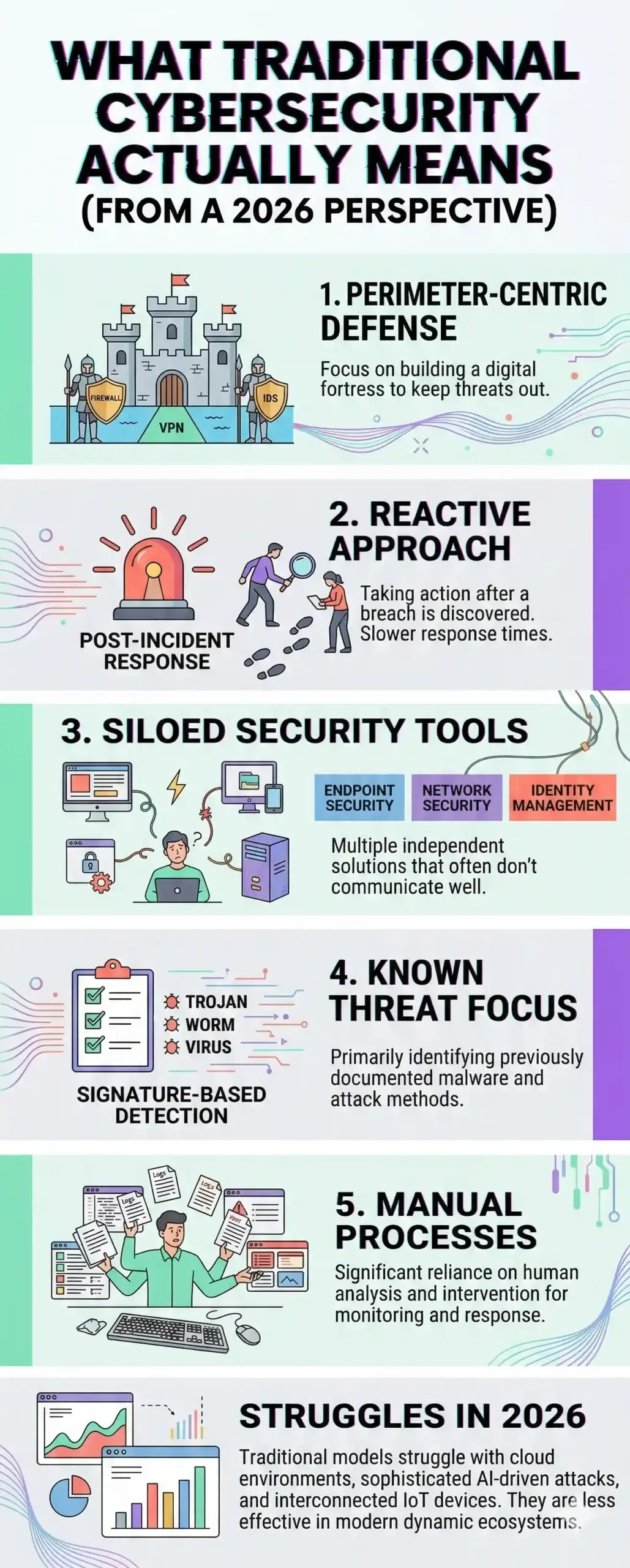
Traditional cybersecurity is built on human-defined rules and signature matching. For example, classic antivirus and network firewalls look for known bad files or suspicious traffic patterns. If a file matches a “bad list” of malware or a data packet breaks a rule, the system blocks it. This method works well against threats that have been seen before. Many companies still use just this basic setup: strong passwords, antivirus software, a firewall, and maybe multi-factor login, to protect themselves. On paper, such measures stop the obvious threats.
In the past, this might have been enough: viruses slowed down, hackers used blunt attacks, and intruders generally behaved unlike normal users. But as BNMC notes, modern attacks don’t crash through the front door anymore; they quietly blend in. They may use real logins or trusted tools, so traditional defenses treat them as harmless. In short, traditional security “is built around recognition, not understanding”. It has a very specific view of what a threat looks like, and outside that, bad actors can slip by.
Defining AI-Driven Cybersecurity
AI cybersecurity turns that model on its head by teaching machines to learn from data. Instead of only blocking known bad signatures, AI tools watch behavior. They build a baseline of “normal” for users and systems, and then flag or stop anything that deviates too much. As OpenEDR explains, traditional defenses “rely on human-defined rules, which can’t adapt quickly”, whereas AI-driven systems “learn from data, recognizing patterns and detecting anomalies” that traditional tools would miss. In practice, this means AI-based systems feed huge logs of activity into machine learning models. Those models digest everything (logins, file access, network traffic) and identify subtle clues of trouble.
For example, an AI might notice a user who normally logs in from New York suddenly accessing sensitive files from Tokyo late at night – behavior that would likely look normal to a firewall. Since AI systems keep learning, they gradually become better at spotting even new tactics. In everyday language, you could say AI cybersecurity works like a super-watchful guard that never sleeps. It keeps track of patterns (like “John always works 9-to-5”) and is immediately suspicious when something falls outside that pattern (like “John logging in on a holiday”). This adaptive approach is why AI security is often described as behavior-based and pattern-driven, compared to traditional signature-based methods.
How AI Enhances Threat Detection and Response
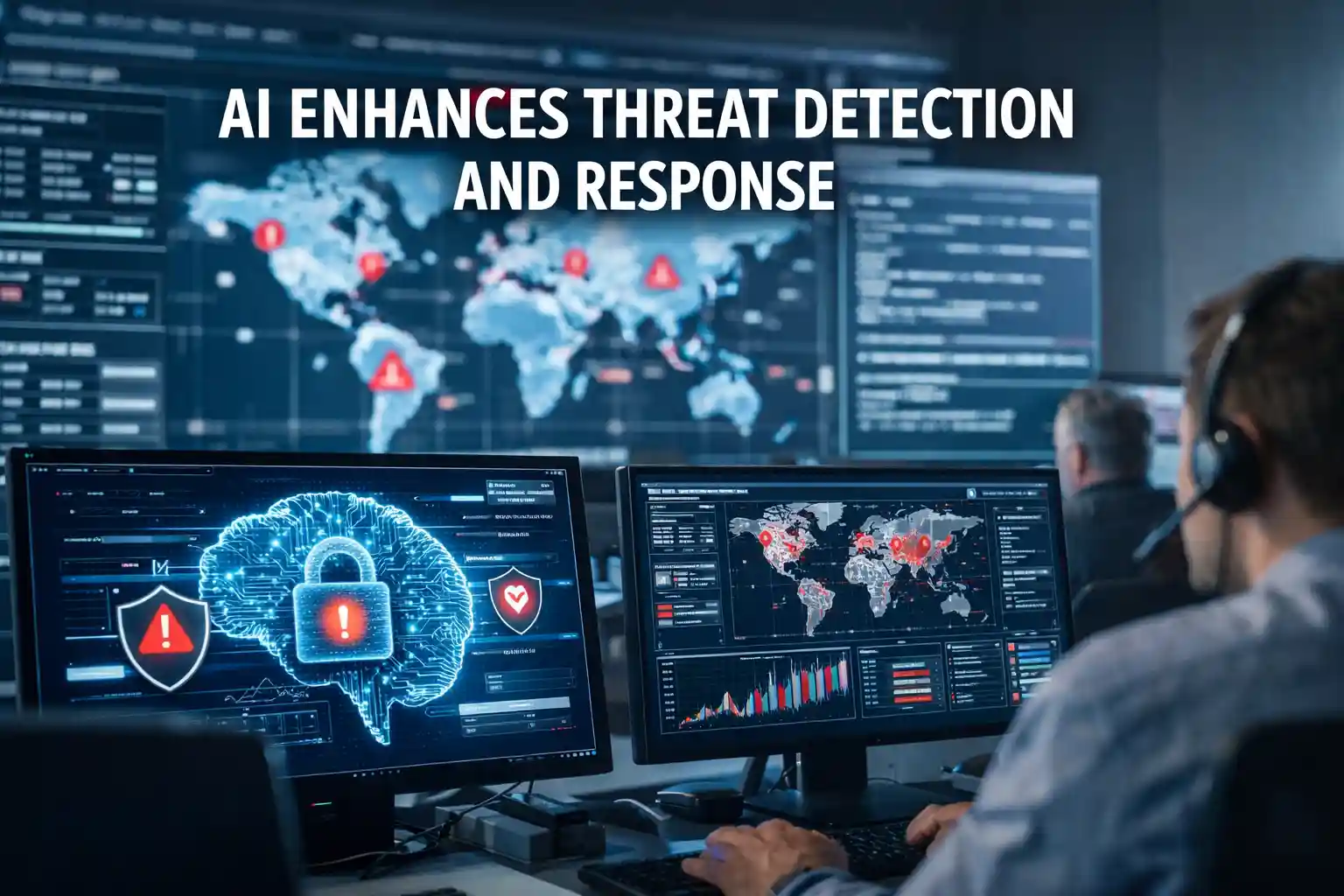
One big way AI changes the game is speed and scale. AI systems can process millions of data points per second – something no human or rule-based system can match. In practical terms, AI can watch all network traffic, email logs, and user actions in real time. It can flag a tiny irregularity the instant it happens. For example, an AI algorithm might automatically notice an unusually large file download or a login attempt from an unfamiliar device, and then act immediately to contain it.
BlackFog reports that AI lets attackers and defenders operate at much greater speed and scale, meaning both sides can run thousands of tasks in parallel with minimal oversight. In defense, this works to our advantage: AI isn’t tired or distracted. It can survey 24/7 and step in on the spot. This “speed” advantage is a key difference: while traditional detection might only catch an attack hours or days later, AI aims to catch or even predict it instantly.
AI also shines in detecting novel threats. Classic tools miss anything that doesn’t match their signatures. By contrast, machine learning models excel at anomaly detection. They learn what normal traffic and behavior look like and then uncover subtle deviations. For instance, AI might detect a form of fileless malware (which leaves no usual footprint) simply because the process is behaving oddly. In other words, AI can find a whole class of new or “unknown” attacks that would slip by static scanners.
As BNMC puts it, basic security “only protects against known problems”, whereas AI security “looks for unknown and evolving ones”. This makes AI particularly useful for stopping advanced attacks like zero-days or polymorphic malware that constantly changes its code. Essentially, AI adds a layer of intuition and prediction: rather than waiting for rules to be updated, it can identify and block threats based on learned patterns.
Another advantage is reducing false alarms. Traditional systems often generate many false positives because every anomaly triggers an alert, even if it’s benign. AI tends to be smarter about context. For example, an AI might learn that a batch of thousands of file accesses is normal during midnight backups, and won’t flag it, whereas it would flag that the first few times.
OpenEDR notes that AI “reduces false positives by distinguishing between normal and abnormal behavior”, helping teams focus only on real threats. In practice, this means security analysts spend less time chasing phantom problems and more time on actual incidents. Overall, AI improves both detection and response: it doesn’t just identify threats faster, it can also trigger automated defenses. Many AI tools can automatically quarantine a machine or shut a port as soon as an attack is detected, effectively isolating the threat in real-time. This is a big difference from older tools, which often require a human to decide when and how to react.
Key Advantages and Use Cases of AI Security
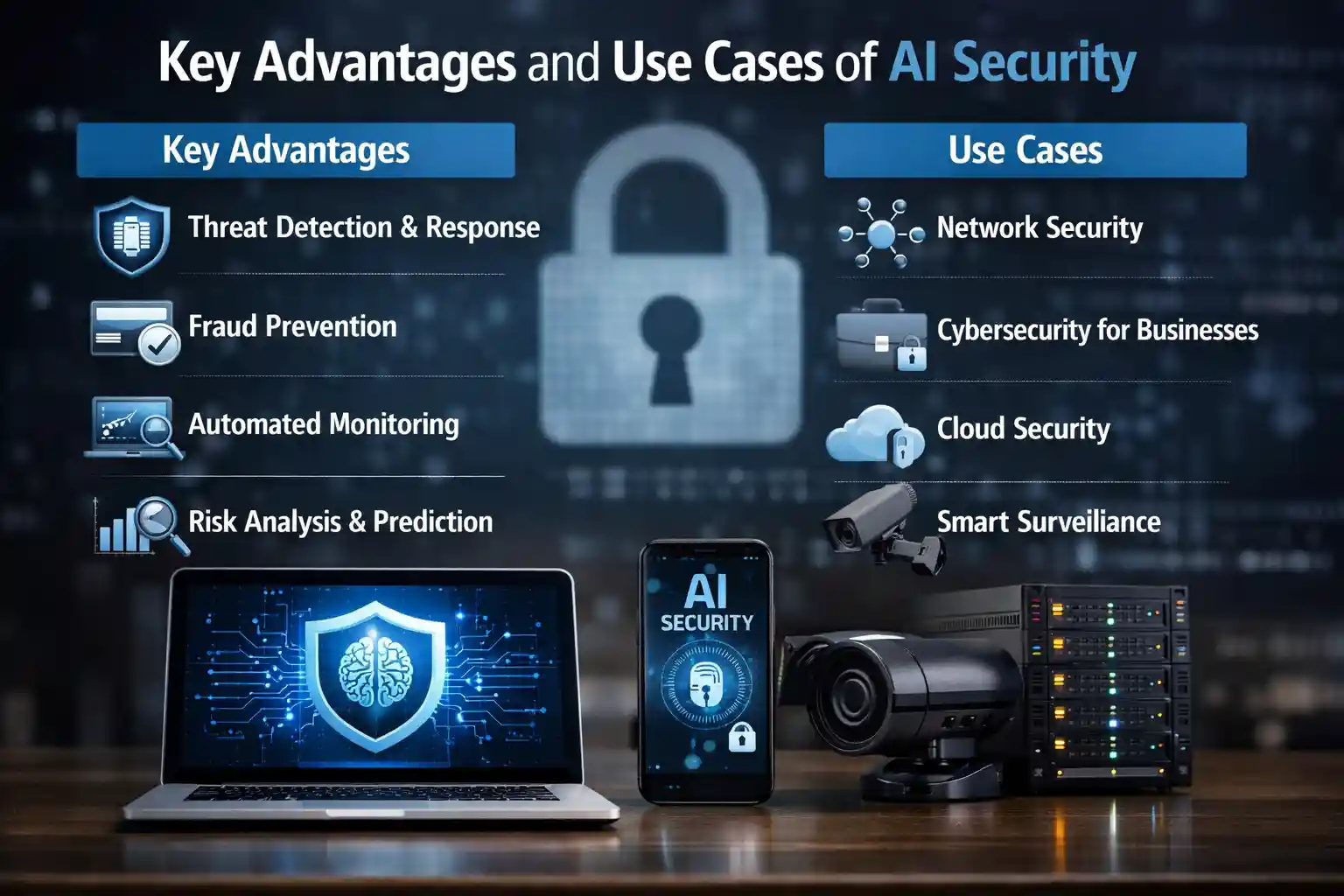
AI in cybersecurity brings several key benefits. First, there is proactivity. AI systems can hunt for threats that haven’t happened yet by analyzing trends. For example, if AI spots small probes or scans that suggest a hacker is testing defenses, it can alert the team before an actual breach starts. This kind of predictive power is something traditional tools simply can’t match. Second, AI provides continuous monitoring. It never sleeps, meaning organizations get 24/7 surveillance without needing a squad of human analysts at all hours. With traditional setups, once humans clock out, visibility drops.
Another benefit is handling complex, large-scale environments. Big companies with cloud services, IoT devices, and remote workers have too many touchpoints for manual oversight. AI scales to cover them. It can track thousands of sensors or endpoints simultaneously. A Cygnostic report notes that AI cybersecurity startups excel in sectors like financial services and healthcare, where “rapid, real-time analysis” of large datasets is crucial. In these settings, AI helps protect customer data and critical infrastructure by analyzing big data quickly. In contrast, a small business with a couple of servers might still rely largely on basic firewalls and antivirus software. That said, even small setups benefit if they scale up.
AI also tends to speed up incident response. For example, AI-driven systems can automatically isolate a compromised device or block a malicious payload as soon as they spot it. This cuts down the “mean time to recovery” (MTTR) significantly. Instead of waiting for a human to manually react, AI acts in real time. Moreover, AI tools can integrate threat intelligence from around the world, learning from the latest attacks globally and updating defenses on the fly. This makes them more resilient against new attacks. As OpenEDR explains, AI systems become “resilient against zero-day exploits and advanced persistent threats” by continuously evolving.
Challenges and Limitations of AI-Driven Security

Of course, AI security isn’t perfect. One challenge is data quality and bias. AI only learns from the data it’s given. If that data is incomplete, biased, or outdated, the AI’s decisions may be flawed. As one analysis points out, “if [training] data is flawed, incomplete, or compromised, the AI’s defenses can be weakened”. In simpler terms, garbage in, garbage out. Attackers have even developed techniques like data poisoning: they subtly corrupt the data used to train AI so that the system misses certain threats. This means organizations must manage and protect their training data carefully.
Another limitation is overreliance and complexity. Some might worry that AI makes things automatic and invisible. In reality, AI tools still need human oversight. Security experts stress that AI is more like a co-pilot. A traditional approach might have meant an analyst manually reviewing logs, whereas AI might flag an issue. But if the AI is wrong or attacked, a human still needs to step in. As Singleclic notes, security guards and analysts aren’t being replaced; rather, “AI will empower, not eliminate, human roles”. In practical terms, a guard dog with new tech is still a guard dog that needs a handler.
AI systems can also be expensive and resource-intensive. They often require specialized hardware (like GPUs) and skilled personnel to manage. This can be a barrier for smaller organizations. Plus, like any software, they need updates and maintenance to stay sharp. Ironically, one strength of traditional methods is their simplicity and transparency: if something goes wrong with a firewall rule, a human can often see the cause and fix it. AI models are more opaque; it can be harder to understand why an AI flagged something. This has led to an emphasis on explainable AI in cybersecurity so that decisions are not a complete black box. Finally, attackers use AI too. AI-powered malware, phishing campaigns, and deepfakes mean the threat landscape is evolving. For defenders, this is partly why we need AI – but it also means AI-driven protection must continuously adapt.
Integration: The Hybrid Security Model
Given these realities, the consensus among experts is that the best approach combines both methods. It’s not a matter of AI versus traditional – it’s AI and traditional. Modern organizations are adopting a hybrid model. In this model, rule-based tools and human expertise sit side by side with AI analytics. Traditional defenses (firewalls, access controls, human review processes) continue to provide a solid baseline and fail-safes. At the same time, AI systems run behind the scenes, looking for what rules might be missed.
For instance, a company might still use conventional firewalls and intrusion prevention, but also deploy an AI-driven SIEM that watches user behavior. Singleclic explains that “AI transforms how companies defend their assets, but it won’t completely replace traditional methods”. In practice, that means organizations often layer AI alerts on top of existing systems. When a potential incident occurs, AI might catch it first and either block it automatically or raise a high-priority alert for a human. This hybrid setup can be very powerful: it leverages AI’s speed while keeping humans in the loop. In a sense, human expertise still decides the overall strategy, but AI tools execute heavy lifting. Experts even coined terms like “human-AI teaming” for this collaboration.
Many security professionals also emphasize starting small when adding AI. They pilot one AI service (like anomaly detection) in a contained environment, measure its impact, and then expand. They also continuously train staff to interpret AI outputs. The goal is to let AI handle the repetitive, data-heavy tasks (for example, scanning millions of logs), while people focus on judgment calls and complex investigations. In this way, organizations get the best of both worlds: robust, rule-based checks complemented by smart, adaptive monitoring.
Real-World Examples and Industry Insights
In practice, different environments call for different balances. For example, Cygnostic notes that industries under heavy regulation or with lots of sensitive data – like finance and healthcare often gain the most from AI’s real-time analysis and quick response. These sectors face sophisticated threats and value AI’s rapid detection. On the other hand, smaller businesses with simpler networks might rely more on traditional tools simply due to budget or inertia, though even they are increasingly adding some AI features (like automated patching or spam filters).
One vivid example is how authentication has evolved. Traditional login methods (passwords, tokens) can be augmented with AI. As a Coslat blog explains, AI can analyze behavioral biometrics (like typing rhythm) alongside a password. This makes it much harder for an attacker with stolen credentials to succeed. In other words, the old key (password) is checked along with a fingerprint of behavior that AI understands. Another use case is intrusion detection: classic IDS systems simply flag known bad signatures. Modern AI-driven IDS instead profiles normal traffic and flags tiny deviations (e.g., a device suddenly communicating with an unusual external server).
We also see hybrid deployments in customer-facing products. Many next-gen antivirus or EDR (endpoint detection/response) tools now include AI modules. They still have signature lists for known viruses, but layer on AI analysis of file behavior and system calls. Similarly, cloud providers incorporate AI to monitor traffic patterns across their data centers. In short, the real-world move is toward blending both approaches. Even Singleclic advises clients to combine “AI-based threat detection and prevention” with “network and endpoint security” and 24/7 monitoring. The takeaway: nobody is writing off the old ways entirely, but most experts say you’d be unwise to rely on them alone in 2026.
Future Trends and Outlook
Looking ahead, the line between AI and traditional security will continue to blur. Many predictions suggest this partnership will deepen. For example, Cygnostic cites industry data: by 2025, 64% of organizations plan to prioritize real-time monitoring (often AI-driven), and 80% emphasize rich telemetry in cloud environments. This shift acknowledges that modern threats require the agility of AI plus the reliability of proven methods. In practical terms, we expect more tools to natively integrate AI capabilities. For instance, network firewalls might use embedded ML to spot zero-day threats, or corporate email systems might use advanced NLP to filter AI-generated phishing at scale.
Another trend is AI’s own evolution. As AI models grow more powerful, they will hopefully become better at explaining themselves (“explainable AI”) and managing privacy concerns. Regulators are already paying attention: guidelines like the EU’s AI Act and NIST standards will likely influence how AI cybersecurity tools are built and used. Additionally, AI is likely to drive automation in new areas, like auto-remediating detected vulnerabilities before attackers strike. However, these advances come with caveats. As OreateAI cautions, AI’s effectiveness hinges on data quality, and attackers are also getting more creative with AI-powered tools (e.g., highly personalized phishing or poisoned training data).
In short, the cybersecurity field is moving toward a future where AI and traditional methods coexist. AI will handle the grunt work of data analysis and adapt quickly, while traditional approaches and human insight provide grounding and oversight. Organizations that stay flexible, learning from both AI-driven innovation and traditional best practices, will be best positioned to defend against tomorrow’s threats. No matter how advanced technology becomes, experts stress that experienced analysts and solid security fundamentals will always matter.
Author’s Recommendations
From my perspective as a security expert, I recommend a balanced, step-by-step approach. First, don’t throw out your legacy tools. Keep firewalls, access controls, and skilled staff in place. At the same time, start experimenting with AI in one area. For example, try an AI-driven anomaly detector for your network logs or an AI-enhanced phishing filter for emails. Monitor its impact: Does it catch issues the old tools missed? Does it generate a lot of noise? Learn from it.
Focus on training and process, too. Ensure your team understands AI outputs and can question them. Encourage them to see AI as an assistant, not a replacement. Keep improving your data hygiene: feed clean, representative logs into any AI system. This will make the AI’s alerts more reliable. Also, always have a human review policy for critical decisions. In short, treat AI as a force multiplier. Let it handle tedious, high-volume tasks like scanning data and looking for anomalies. This frees your team to think strategically.
Finally, stay informed and flexible. The security landscape is changing fast. Keep an eye on new AI features (like real-time remediation tools) but also on regulations or ethical guidelines that might affect you. Regularly test your hybrid defenses with drills. If you find gaps, adjust by tweaking AI thresholds or updating rules. Remember, the goal is resilience: using AI to make your defenses smarter and faster, while still relying on tried-and-true practices and human insight. With this balanced approach, you’ll navigate the future confidently – enjoying the benefits of AI’s speed without losing the wisdom of traditional security.