Prompt Engineering: Is It a Sustainable Career or a Passing Fad?

In 2023, “Prompt Engineer” was hailed as the hottest job in tech, a six-figure role where the primary skill was knowing the “magic words” to whisper to a chatbot. Fast forward to 2025, and the headlines have shifted. Critics are calling it a dead end, a temporary glitch in the matrix until the AI gets smart enough to understand us perfectly.
So, where does the truth lie?
Is Prompt Engineering a sustainable career or a passing fad?
The answer is nuanced: “Manual” prompt engineering (chatting with a bot to get a poem) is indeed a dying task. However, “Systemic” prompt engineering (architecting how AI systems process information) is evolving into one of the most critical engineering disciplines of the decade. We are moving from the era of “Chat Interfaces” to the era of Agentic Workflows.
In this guide, we will cut through the hype and explore the real future of this profession.
Why the AI Whisperer Role is Dying? The Bubble Argument
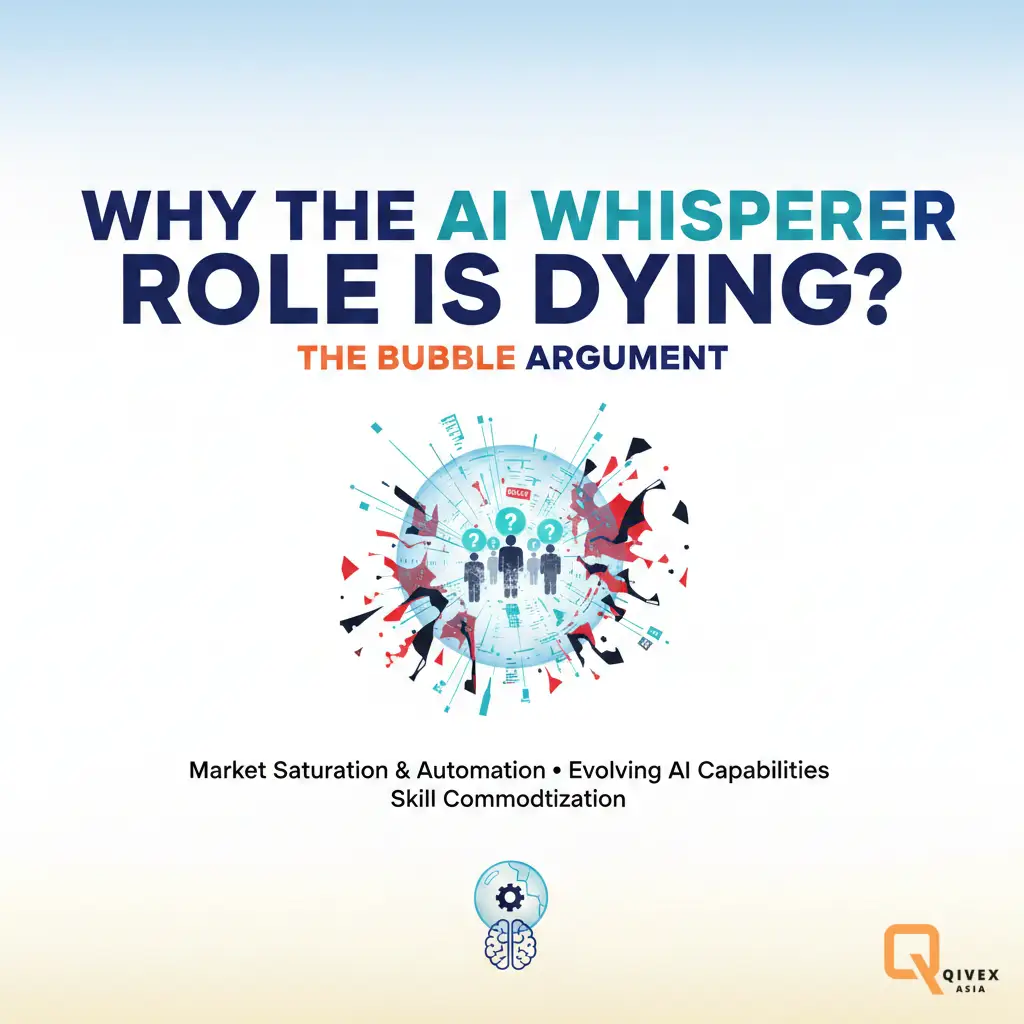
If your definition of prompt engineering is “tweaking adjectives to get a better image from Midjourney,” your job security is at risk. Two major forces are actively obsoleting the “manual” prompter.
The Rise of Auto-Prompting (DSPy)
We are entering an era where code writes prompts better than humans do. Frameworks like DSPy (Declarative Self-Improving Language Programs) treat prompts not as static text, but as optimized parameters.
Instead of a human manually guessing which phrasing works best, the system iterates through thousands of variations, measuring the output against a specific metric, and mathematically selecting the best prompt.
Core Insight: In a recent project optimizing a customer support bot, we initially spent weeks manually refining the “persona” instructions. It was subjective and brittle. Once we switched to a programmatic approach using an optimizer, the system automatically generated a prompt structure we hadn’t even considered—and it boosted the accurate resolution rate by 22%. The machine optimized the machine better than we could.
AI Models Are Getting Smarter
The friction that created the need for prompt engineers, the fact that models were “dumb” and needed coaxing, is disappearing. Newer iterations (like GPT-5 class models or Claude 3.5) have vastly improved reasoning capabilities. They understand intent with less context, rendering the “bag of tricks” required in 2023 (like “take a deep breath” or “think step by step”) largely redundant for basic tasks.
The Evolution: From Prompt Writer to AI Architect
However, as the manual task dies, the architectural need explodes. The role is shifting from writing text to managing the “Full Stack” of AI interaction.
Understanding the “Full Stack” of AI Interaction
A professional in 2025 isn’t just typing into a box. They are managing Context Window Management, orchestrating RAG (Retrieval-Augmented Generation) pipelines, and curating the knowledge base that feeds the model.
Key Concept: You aren’t paid to write a clever response; you are paid to ensure the AI doesn’t hallucinate when analyzing a complex financial report. This requires deep technical knowledge of Vector Databases and Embeddings.
The Shift to Evaluation and Security
With the rise of Agentic Workflows, security is paramount.
Prompt Injection Defense: Companies need engineers who can “Red Team” models actively trying to break them to find vulnerabilities where users might trick the AI into revealing sensitive data.
Evaluation Metrics: It is no longer enough to say, “This output looks good.” Professionals use statistical LLM Ops (Large Language Model Operations) metrics (like BLEU/ROUGE or semantic similarity scores) to prove reliability.
Where the Real Jobs Are in 2025 (The Hybrid Professional)
The standalone “Prompt Engineer” is vanishing. Replacing them is the “Hybrid” professional, someone who combines deep domain expertise with AI Orchestration skills.
Domain-Specific Engineering (The “Subject Matter Expert” + AI)
This is where the high salaries are hiding. A generalist who can prompt ChatGPT is a commodity. But a lawyer who understands Chain-of-Thought (CoT) prompting and Contract Law? That is a unicorn.
Research Note: My analysis aligns with the 2024 State of the AI Workforce Report, which indicated that “AI-First” roles requiring dual competency (e.g., Legal Ops + AI, Biotech + AI) saw a 40% year-over-year salary premium compared to pure technical roles.
AI Product Management & Design
We are seeing the rise of AI Interaction Design. This role focuses on structuring how humans and agents collaborate. It involves deciding when to use Few-Shot Learning (giving the model examples) versus when to fine-tune a model entirely.
[Diagram Concept: A stack showing ‘User Interface’ -> ‘System Prompt’ -> ‘RAG Retrieval’ -> ‘LLM Inference’. The ‘Prompt Engineer’ manages the middle layers.]
Essential Skills to Future-Proof Your Career
If you want to survive the transition, you need to upgrade your toolkit immediately.
Technical Proficiency (Python & JSON)
You must be comfortable with Structured Data Extraction. Modern applications don’t want a paragraph of text; they want a clean JSON object that can trigger a database update.
If you cannot write a prompt that reliably forces a model into JSON Mode to output usable code, you are not building software; you are just chatting.
System Thinking vs. Linear Thinking
You must understand Cognitive Architectures. This means knowing how to break a complex problem into steps using ReAct (Reasoning + Acting) frameworks or Tree of Thoughts logic.
- Linear Thinking: asking the AI a question.
- System Thinking: designing a workflow where the AI plans a search, executes Python code to analyze data, and then summarizes the findings.
Verdict: Fad or Future?
Let’s look at the breakdown.
| Aspect | Status | Why? |
| Manual Prompting | FAD | Auto-optimization and smarter models replace this. |
| Chatbot Personality Design | NICHE | Valid, but small market (Game Dev / Character.ai). |
| AI Systems Engineering | FUTURE | Connecting LLMs to real-world tools requires complex architecture. |
| LLM Ops & Evaluation | FUTURE | Companies need to know their AI is safe and reliable. |
Summary: Stop treating this as a “side hustle hack” or a way to cheat at writing emails. Start treating it as a specialized branch of Software Engineering or Product Design.
Conclusion: The Shift from Magic Words to Reliable Systems
The “Prompt Engineer” of 2023, the person who sold PDF cheat sheets of magic phrases, is gone.
The AI Architect of 2025, the person who builds reliable, model-agnostic systems that solve expensive business problems, is just getting started.
The career is sustainable, but only if you evolve. The value isn’t in the prompt itself; it’s in the System Design that surrounds it.