What is The Main Purpose Of DeSci Decentralized Science? Beyond Grants

What is the Main Purpose of DeSci (Decentralized Science)? A Comprehensive Guide
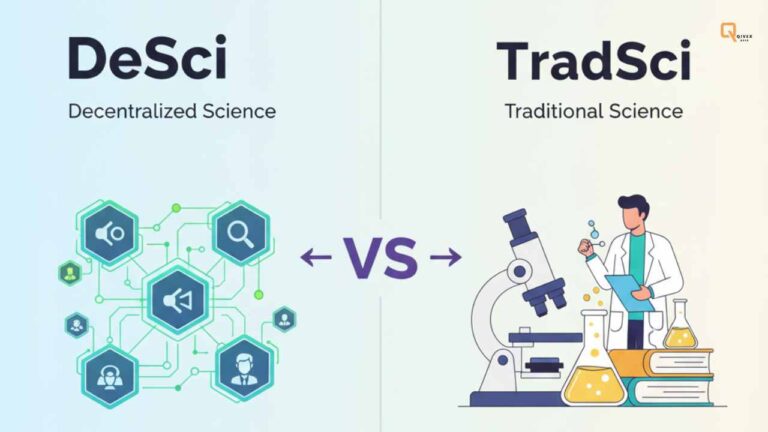
For decades, the scientific machine, often dubbed TradSci (Traditional Science), has operated on a centralized model. It achieved wonders, but cracks are widening in its foundation. If you are reading this, you likely sense the friction: funding bottlenecks, data silos, and a publishing system that prioritizes profit over progress.
Decentralized Science (DeSci) is not merely “science on the blockchain.” It is a fundamental restructuring of how humanity produces, funds, and shares knowledge. It aims to shift the scientific ecosystem from a closed, permissioned environment to an open, permissionless economy.
As someone who has tracked the evolution of Web3 utility since 2017, I’ve moved past the hype cycles to look at the plumbing. The purpose of DeSci isn’t to replace scientists with smart contracts; it’s to replace the bloated administrative layers that slow them down.
The Core Purpose: Why DeSci Exists
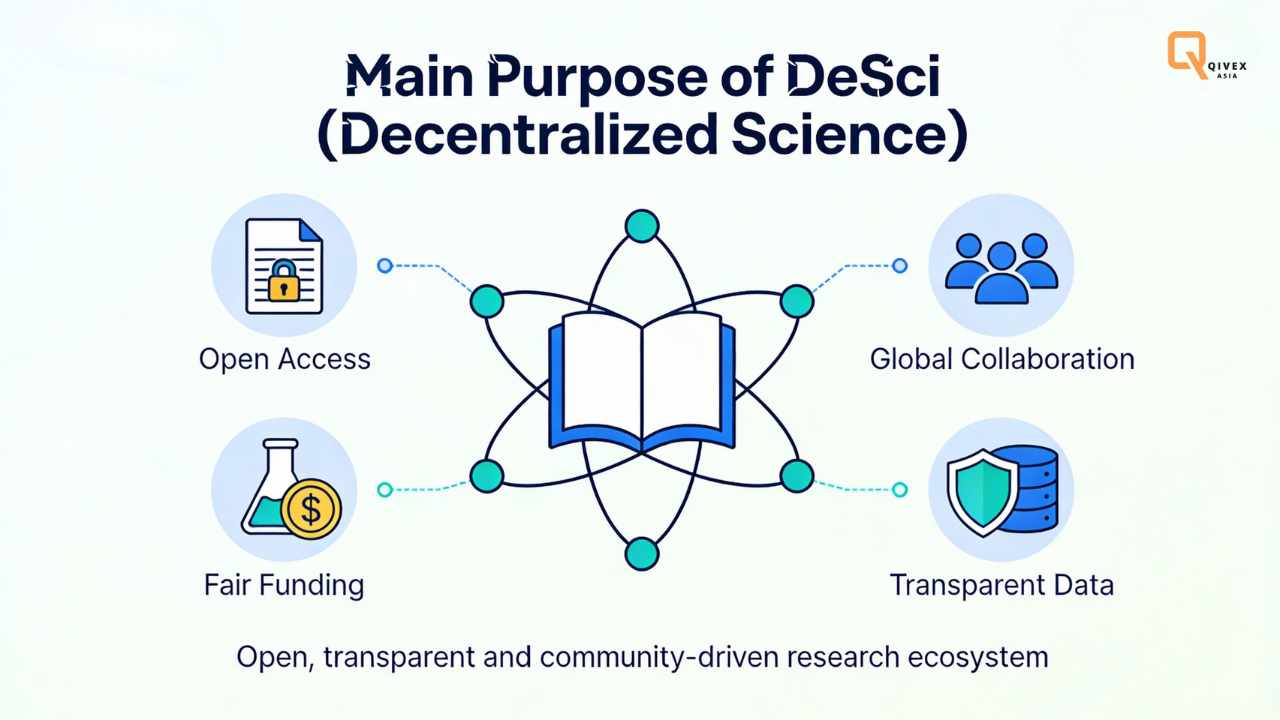
At its heart, the main purpose of DeSci is to build public infrastructure for scientific research using Web3 tools. It’s about aligning incentives so that specific breakthroughs—especially those ignored by big pharma or government grants, can actually see the light of day.
Defining DeSci: The Intersection of Web3, Open Science, and Real-World Research
DeSci sits at the nexus of three domains. It takes the ethos of Open Science (transparency and accessibility) and enforces it using Web3 Science technology.
In a traditional setting, data lives on a university server or a publisher’s database. In DeSci, we aim for Data Availability Layers and the Permaweb (using protocols like Arweave or IPFS). This ensures research data is immutable and censorship-resistant. It’s the difference between renting access to knowledge and owning the infrastructure that houses it.
Solving the “Valley of Death”
One of the most specific purposes of DeSci is bridging the “Valley of Death.” This is the notorious gap between basic research (often funded by government grants) and clinical trials (funded by VCs or Pharma).
Analyst Insight: I recently spoke with a biotech founder who had promising data on a rare disease. Because the potential market size didn’t meet the VC threshold of a “10x return,” the project stalled.
DeSci steps in here. By using decentralized funding mechanisms, communities can fund research that is socially valuable even if it isn’t immediate “unicorn” material for Silicon Valley.
Democratizing Discovery
We are moving from Institutional Gatekeeping to Patient Governance. In the current model, a small board of directors decides what gets researched. DeSci proposes a model where patients, the people actually suffering from conditions, hold governance rights via tokens. They decide which drug targets to pursue.
The “TradSci” Crisis: Problems DeSci Solves
To understand the solution, we must clearly define the problem. The current academic engine is misfiring.
The Funding Black Hole
Grant Writing Fatigue is a massive drain on cognitive resources. Studies suggest principal investigators spend up to 40% of their time writing grants rather than doing science. This creates a culture of hyper-competition where only “safe” ideas get funded.
The Reproducibility Crisis
We are facing a Reproducibility Crisis because negative results are rarely published (a phenomenon known as Publication Bias). If an experiment fails, that data is buried. DeSci incentivizes the publication of all data—positive or negative—often creating an On-chain Reputation for researchers who contribute honest, verifiable data rather than just chasing headlines.
The Paywall Problem
Paywalls are the enemies of velocity. Taxpayers fund research, yet the results are locked behind subscriptions costing thousands of dollars. This limits who can participate in science. DeSci champions Token-gated Access that rewards contributors while keeping the core knowledge open, or entirely open-access models supported by Retroactive Public Goods Funding (RPGF).
How DeSci Works: The Technical & Social Stack

This isn’t just theory; specific technical mechanisms make this work.
The Rise of BioDAOs
The primary organizational unit of DeSci is the BioDAO (Biotech Decentralized Autonomous Organization). Examples include VitaDAO (focused on Longevity) and AthenaDAO (focused on Women’s Health).
A BioDAO works like a cooperative. Members pool funds (often in crypto), review research proposals from universities, and vote on which to fund. If the research yields a patent, the DAO owns (or shares) the IP.
IP-NFTs Explained
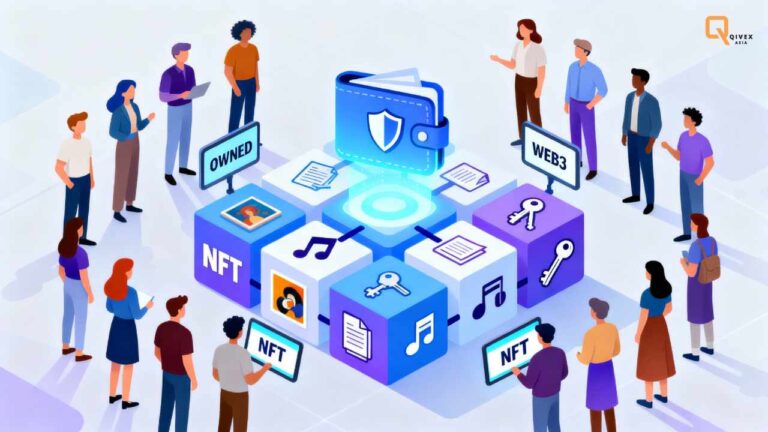
This is where it gets technical. An IP-NFT (Intellectual Property Non-Fungible Token) is not a JPEG. It is a legal engineering feat.
The Legal Wrapper: You cannot put a patent directly “on the blockchain.” Instead, the IP rights are assigned to a real-world legal entity (like an LLC). The ownership of that LLC is then tied to the NFT.
The Utility: Holding the NFT grants Fractionalized Ownership of the IP. This turns sticky, illiquid patents into liquid, tradeable assets. This allows a university to sell a stake in a patent early to raise funds, rather than waiting a decade for licensing fees.
New Funding Models
DeSci utilizes Quadratic Funding to allocate resources. This mathematical formula prioritizes projects with many small backers over projects with few wealthy backers, ensuring funding aligns with broad community sentiment rather than the whims of a single whale.
DeSci Ecosystem & Use Cases (Real-World Examples)
Let’s look at the entities effectively executing this model today.
Longevity & Biotech: VitaDAO and Molecule
Molecule serves as the marketplace protocol; think of it as OpenSea for science. They facilitate the creation of BioDAOs. VitaDAO uses Molecule’s framework to fund longevity research.
Case Study: VitaDAO funded a study at the University of Copenhagen on aperiodicals for extending lifespan. This resulted in the first IP-NFT transfer, proving that a decentralized community could own and manage university-grade IP.
Women’s Health: AthenaDAO
Women’s health has historically been underfunded in TradSci. AthenaDAO aggregates capital to fund research specifically for ovarian aging and reproductive health, areas often ignored by traditional VCs due to misconceptions about market viability.
Open Publishing: ResearchHub
Founded by Brian Armstrong (Coinbase) and others, ResearchHub operates like a GitHub/Reddit hybrid for science. It rewards scientists with ResearchCoin (RSC) for publishing summaries, peer-reviewing papers, and curating content, directly combating h-index gaming.
Decentralized Clinical Trials
Companies and DAOs are exploring Zero-Knowledge Proofs (ZKPs) to handle patient data. This allows a patient to prove they meet the criteria for a clinical trial (e.g., “I am over 40 and have Type 2 Diabetes”) without revealing their identity or exposing their full medical history to a centralized database.
The Frontier: DeSci and Artificial Intelligence (AI4S)
This section is critical for advanced users. The convergence of DeSci and AI (often called AI4S) is where the next exponential leap occurs.
Incentivizing Data Labels
AI models are only as good as their data. In biology, data labeling is expensive and requires PhD-level knowledge. DeSci protocols can use crypto incentives to reward scientists for cleaning and labeling datasets used to train models. This ensures high-quality inputs for AI drug discovery.
Compute-for-Science
We are seeing the rise of LabDAO, which focuses on cloud labs. By utilizing decentralized GPU networks, DeSci projects can run massive protein folding simulations or molecular dynamics models at a fraction of the cost of centralized cloud providers.
Challenges and Risks of Decentralized Science
We must remain grounded. DeSci is nascent and carries inherent risks.
Regulatory Hurdles
The regulatory status of IP-NFTs and DAO tokens is complex. Are they securities? How does IP ownership work across borders? These questions are actively being litigated. Smart Contracts are law on the blockchain, but they must interface with traditional courts.
Quality Control
Without the centralized gatekeepers of TradSci, how do we prevent “junk science”? An open permissionless system risks noise. The community relies on On-chain Reputation and Verifiable Credentials to filter quality, but the systems are still maturing.
Bioethics
Who ensures ethical standards in a DAO? TradSci has Institutional Review Boards (IRBs). DeSci needs to establish “Community IRBs” that maintain strict ethical guidelines without stifling the speed of innovation.
The Future Outlook: Will DeSci Replace TradSci?
The Hybrid Model
It is unlikely DeSci will “kill” TradSci. The future is hybrid. We are already seeing universities partnering with DAOs. The university provides the talent and the labs; the DAO provides the funding, the speed, and the distribution network.
Conclusion
The purpose of DeSci is not to destroy the scientific establishment, but to upgrade its operating system. It moves us from a world of “Trust the Science” (appeal to authority) to “Verify the Science” (audit the code and data).
For those dealing with the inefficiencies of legacy systems, DeSci offers a glimpse of a frictionless future where funding follows talent, and data belongs to the public.
Frequently Asked Questions (FAQ)
What is the difference between Open Science and DeSci?
Open Science advocates for free access to data but lacks an incentive model. DeSci provides the financial rails (tokens, NFTs) to reward people for practicing Open Science.
How do IP-NFTs legally work?
They use a legal wrapper (usually a Swiss Association or US LLC). The NFT controls the rights to the IP held by that legal entity. Transferring the NFT transfers the control of the IP rights.
Can anyone join a DeSci DAO?
Yes. Most are permissionless. You can join their Discord, contribute labor, or purchase governance tokens to participate in voting.